The Elvish Calendar: How Time Worked in Middle-earth
Most fantasy worlds borrow the same twelve-month calendar readers already know and just rename the months. Tolkien, characteristically, didn’t take the easy route. The Elvish calendar reflects an entirely different way of thinking about time, built with the same careful, structured logic he applied to language itself, right down to how many seasons a year actually contains.
Here’s how it works, and what it reveals about how Elves experienced time differently than mortals in Middle-earth.
Why Tolkien Built a Separate Calendar System
For Tolkien, a constructed world needed a constructed sense of time to feel genuinely lived-in, not just borrowed from the real world with a fantasy coat of paint. Elves, being immortal, naturally experience time differently than mortal characters, and Tolkien reflected that directly in how their calendar divides the year. It’s a small detail most readers skim past, but it’s exactly the kind of internal consistency that made Middle-earth feel real rather than assembled.
Six Seasons, Not Four
Here’s the detail that surprises most people first encountering the Elvish calendar: it divides the year into six seasons rather than the familiar four. Each season carries its own Quenya name, reflecting subtler shifts in light, growth, and temperature than a standard four-season structure captures. This finer division fits naturally with Elvish reverence for the natural world, treating seasonal change as something worth describing with more precision than mortals typically bother with.
That extra granularity isn’t decorative either; it reflects a people who, given effectively unlimited time, simply paid closer attention to gradual change.
The Structure of the Elvish Year
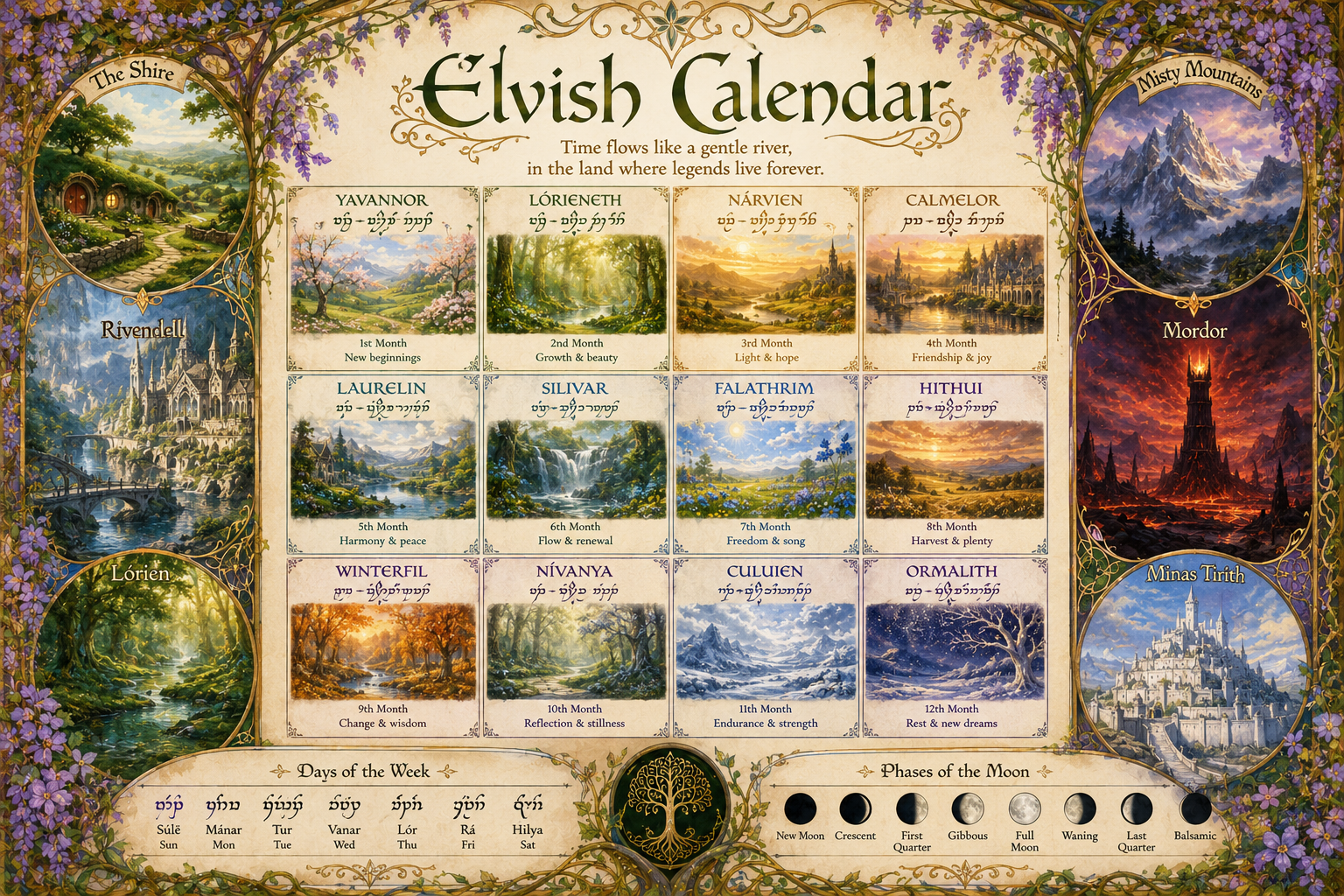
The Elvish calendar, known formally as the Calendar of Imladris in some of Tolkien’s writing, organizes days into structured months distinct from the Gregorian system readers are used to. Certain days sit outside the regular month structure entirely, functioning as special, unnumbered days marking seasonal transitions, a structural choice that emphasizes transition itself as meaningful rather than incidental.
This structure appears in varying forms across Tolkien’s writing, since, much like the languages themselves, he revised calendar details across drafts and appendices over time.
Sindarin and Quenya Time-Related Vocabulary
A handful of terms show up consistently in discussions of Elvish timekeeping:
- Loa – Quenya for “year,” specifically referring to a full solar cycle
- Coranar – a Quenya term tied to the solar year as a measured unit, used more formally
- Yén – a much longer Quenya unit, roughly corresponding to 144 solar years, reflecting the vastly different timescale immortal Elves might reasonably track
That last term says a lot on its own. A word for measuring time in blocks of over a century only makes sense for a people who genuinely expected to live that long.
What the Calendar Reveals About Elvish Culture
Time-related vocabulary and structure reflect the same worldview found throughout Sindarin and Quenya more broadly: careful, deliberate attention paid to the natural world rather than abstract convenience. A calendar built around six subtly shifting seasons, rather than four broad ones, mirrors the same reverence for nature found in Elvish vocabulary for trees, light, and water discussed elsewhere in Tolkien’s languages.
Understanding this connection helps explain why Elvish nature and time vocabulary both tend to be so richly, reliably documented compared to more abstract, modern concepts.
Final Thoughts
The Elvish calendar is one of Tolkien’s quieter feats of world-building, easy to overlook but genuinely revealing once you notice it. Six seasons instead of four, unnumbered transitional days, and time units built for immortal lifespans all reflect the same meticulous, internally consistent thinking Tolkien brought to everything else in Middle-earth. It’s a reminder that even something as mundane as a calendar became, in his hands, another piece of carefully constructed language.