Elvish to English Translator: Decode Sindarin & Quenya
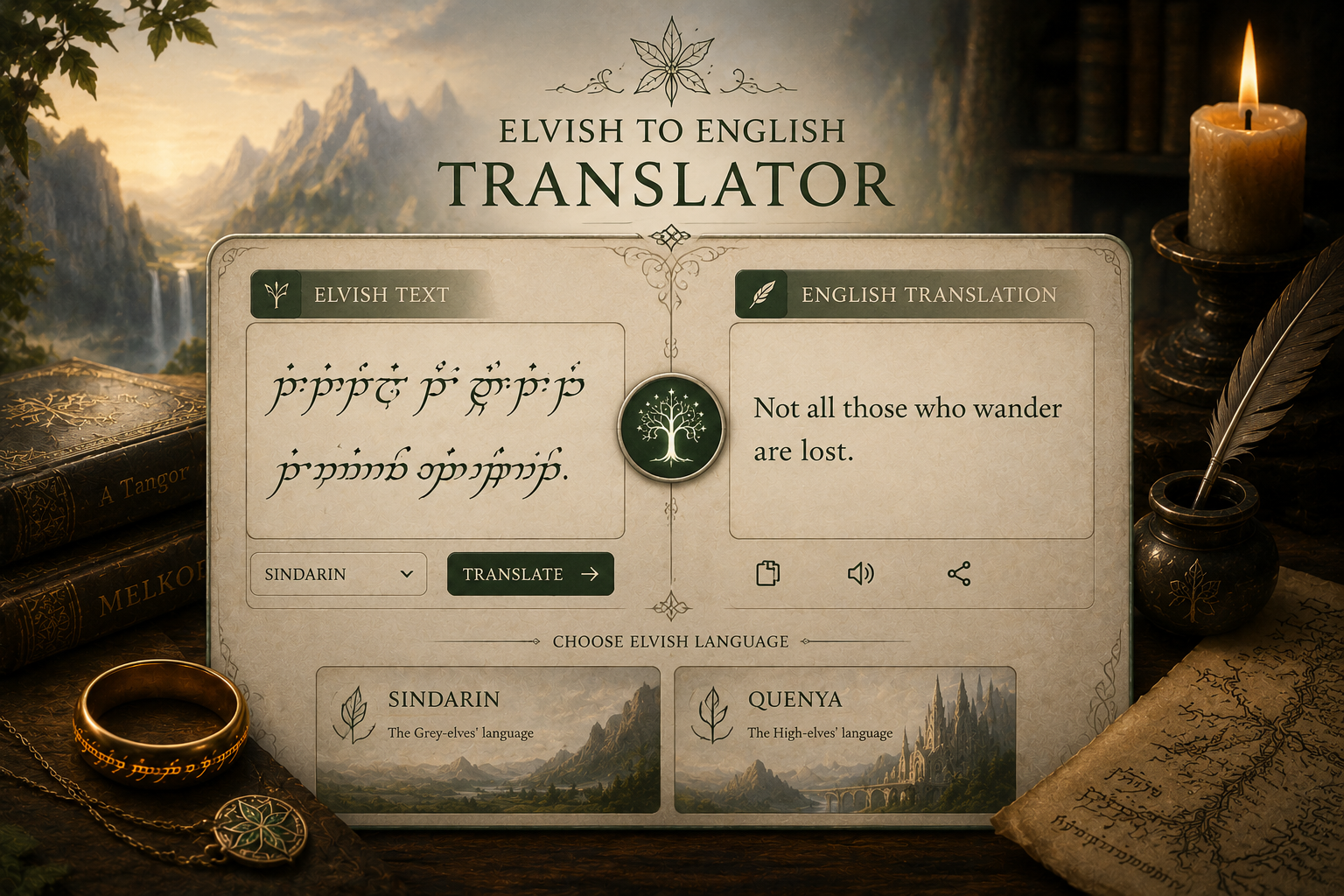
Our Elvish to English Translator works the reverse direction from most tools on this site. Instead of turning your English into Elvish, it takes a word, name, or inscription you already have in Sindarin or Quenya and tells you what it actually means in plain English. Paste in a phrase from a book, a tattoo you’re double-checking, or a line you found somewhere online, and this Elvish English Translator identifies the language and gives you an honest, documented meaning back.
That word “honest” matters here more than almost anywhere else on this site. A huge amount of Elvish floating around online isn’t real Elvish at all. It’s either invented from scratch, or it’s ordinary English simply written in Elvish-looking letters, a decorative trick rather than an actual translation. Before decoding anything, it helps to understand what you’re actually looking at.
Which Elvish Are You Trying to Decode?
This is worth pausing on, because “Elvish” doesn’t mean just one thing, and getting this wrong before you even start leads to frustrating, meaningless results. If your text comes from Tolkien’s world, The Lord of the Rings, The Hobbit, The Silmarillion, or The Rings of Power, you’re almost certainly dealing with Sindarin or Quenya, the two Elvish languages this tool decodes. If instead your phrase comes from a Dungeons & Dragons campaign or another tabletop game, you’re dealing with a completely different constructed language. D&D’s Elvish has its own separate vocabulary and grammar, unrelated to anything Tolkien built, and running it through a Tolkien-based Elvish to English translator won’t produce a meaningful result, since the words simply don’t overlap.
If you’re not sure which one you have, look at the source. Book quotes, film dialogue, and fan content tied to Middle-earth point to Sindarin or Quenya. Character sheets, campaign notes, and generic fantasy naming tools usually point somewhere else entirely.
How to Use This Elvish to English Translator
Getting a clean, reliable result comes down to a few simple habits.
Because this tool works from documented vocabulary, a genuine Sindarin or Quenya word will decode cleanly and confidently. Text that doesn’t match anything real gets flagged as such, rather than forced into a plausible-sounding but fabricated meaning.
Genuine Elvish vs. Decorative Letter-Swapping
This distinction comes up constantly with reverse translation, and it deserves its own explanation. Plenty of “Elvish” text circulating online was never actually translated at all; it’s English run through a font generator that swaps Latin letters for Elvish-looking shapes, one for one. Visually, the result can look convincing. Linguistically, it’s just English wearing a costume, and decoding it as if it were real Sindarin or Quenya produces nonsense.
Our Elvish Font Generator vs Real Translator guide covers this exact problem from the other direction, explaining how to spot the difference before you translate something. When decoding, the same logic applies in reverse: if a phrase doesn’t match any documented Sindarin or Quenya word or pattern, the honest answer is that it likely isn’t genuine Elvish at all, not a forced, made-up interpretation.
Common Elvish Words and Their English Meanings
A handful of Sindarin and Quenya words show up constantly in books, fan content, and things people want decoded, and they’re a good starting point if you’re new to reading Elvish back into English.
|
Elvish |
English |
|---|---|
|
Edhel |
Elf |
|
Anor |
Sun |
|
Ithil |
Moon |
|
Suilad |
Greetings |
|
Mellon |
Friend |
|
Aiya |
Hail / greetings |
|
Elen |
Star |
|
Namárië |
Farewell |
Mellon carries particular weight here, since it’s the word inscribed on the Doors of Durin, famous for opening the gate the moment it’s spoken aloud. If you’re testing this Elvish to English translator for the first time, feeding it a word like this is a solid way to see how it handles well-documented vocabulary.
Reading Names and Inscriptions
A lot of people come to an Elvish English Translator not for a single word, but to understand what a name actually means. Elvish names in Tolkien’s writing are rarely arbitrary; they’re often small, meaningful phrases in disguise, describing light, nature, valor, or lineage. Decoding a name like this can reveal a description embedded directly in the sound of it, something a casual reader would otherwise miss entirely. If you’re specifically curious about naming, our guides on Elvish baby names and Elvish character names go deeper into how these meanings work and where they come from.
Inscriptions work similarly, though usually with more context to lean on. A short carved or written phrase, from a book, a piece of jewelry, or fan art, often decodes more reliably than an isolated single word, since surrounding words help confirm which language and which grammatical form is actually being used.
How Accurate Is This Elvish to English Translator?
The honest answer: this tool works best with genuine, documented Sindarin or Quenya vocabulary, names, and well-known phrases. When your input matches something Tolkien actually wrote or documented, the decoded meaning will be reliable and traceable back to a real source. When it doesn’t match anything real, whether because it’s invented, decorative, or drawn from an unrelated fictional language like D&D’s Elvish, we say so rather than guessing at a meaning that sounds plausible but isn’t grounded in anything.
This matters because Tolkien’s Elvish languages, while genuinely deep and well-documented compared to most constructed languages, were never finished as complete modern languages. Some words and grammatical constructions remain uncertain or debated among Tolkien linguists, and any tool claiming perfect, unambiguous decoding for absolutely any Elvish-looking text is overpromising.
Limitations of Elvish to English Translation
A few honest limitations are worth knowing. Decoding works best with short, documented words and phrases; long or unusual text is more likely to include something Tolkien never wrote down, which can’t be decoded with real confidence. Text that’s actually decorative, English letters dressed up in Elvish-style shapes rather than genuine translated vocabulary, won’t decode into anything meaningful, because there’s no real Elvish underneath it to find. And text from unrelated fictional languages, like D&D’s own Elvish, won’t match Tolkien’s Sindarin or Quenya vocabulary at all, since the two have no actual linguistic connection despite sharing a name.
No Elvish to English translator, ours included, should be treated as a final, unquestionable authority, especially for anything meaningful like confirming a name’s history or verifying a tattoo before it’s permanent. A quick cross-check against a documented source is always worth the extra few minutes.