Sindarin to English Translator: Decode Grey Elvish
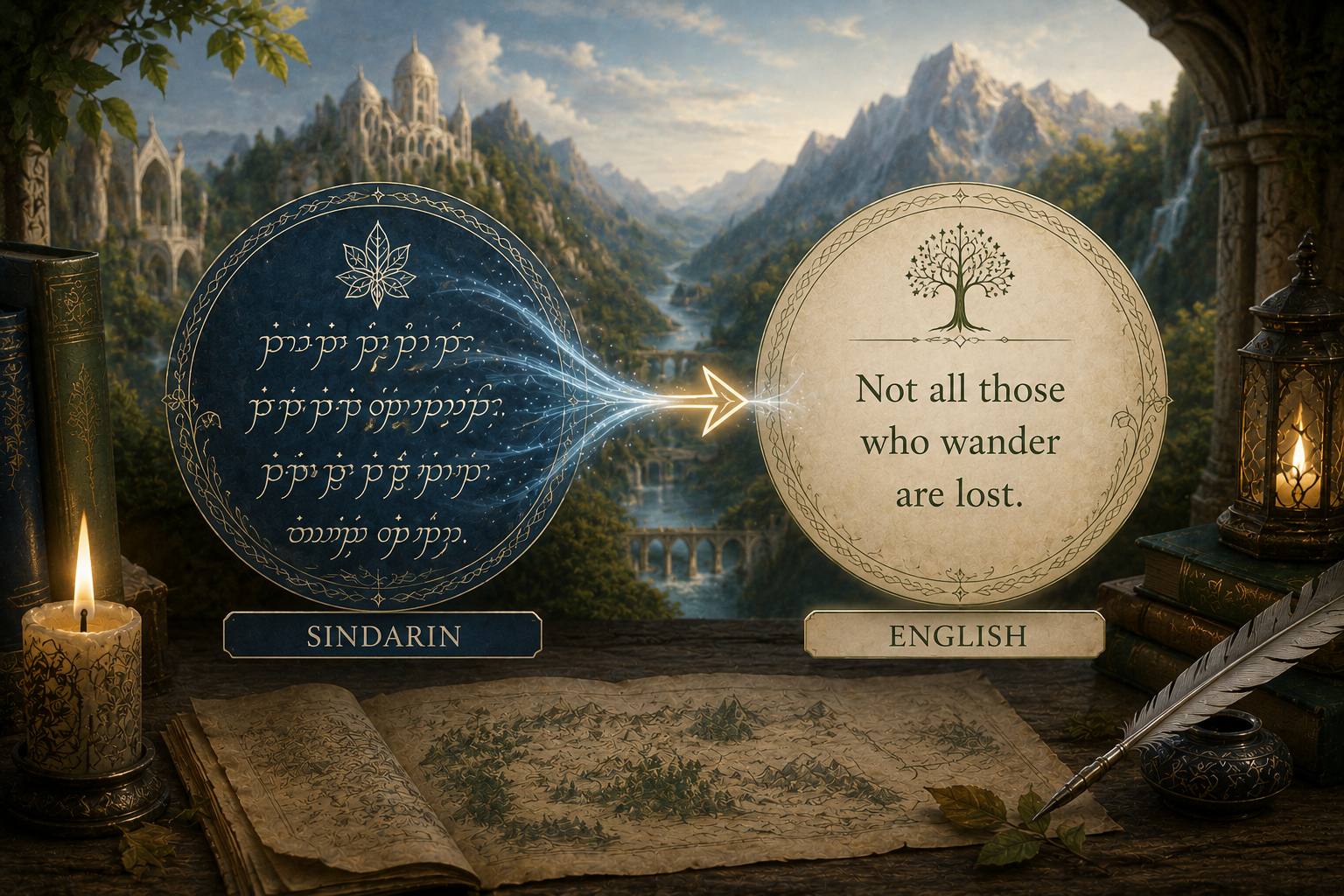
Our Sindarin to English Translator works in reverse from a standard English to Sindarin tool. Instead of building new Sindarin from your English text, it takes a word, name, or line you already have in Sindarin, the everyday Elvish heard throughout most of The Lord of the Rings, and decodes it into plain English. Paste in a line of Elvish dialogue, a name you’ve come across, or something you’re checking before a tattoo, and this tool identifies it against real, documented Sindarin vocabulary rather than a plausible-sounding guess.
Sindarin has no native speakers in the way a living language does. Like Quenya, it exists today as a linguistic hobby, studied and used by a genuinely dedicated but relatively small community of fans, scholars, and enthusiasts, best estimated in the low thousands worldwide rather than anything close to a mainstream language. That’s part of why getting a decode right matters so much here: there’s no huge, self-correcting body of native speakers to catch an error, so accuracy has to come from the documented source material itself.
Which Elvish Language Do You Actually Have?
Before decoding anything, it’s worth confirming your text is genuinely Sindarin. This trips up more people than you’d expect, since “Elvish” gets used loosely online to mean three genuinely different things: Tolkien’s Sindarin, his separate and more formal Quenya, and an entirely unrelated constructed language used in Dungeons & Dragons that happens to share the same casual name.
If your phrase comes from film dialogue, since Arwen, Legolas, and Aragorn all speak Sindarin throughout Peter Jackson‘s trilogy, or from a name or place in Middle-earth, a Sindarin to English translator is exactly the right tool to check it against. If it feels more ceremonial or comes from a song or old lore passage, it might actually be Quenya instead, and our Quenya to English Translator is the better tool to check it against.
Attested Sindarin vs. Neo-Sindarin
Here’s a distinction almost no casual guide makes clear, and it genuinely affects how confidently anything decodes. “Attested” Sindarin refers to words and grammar Tolkien himself actually wrote down and published or left in his notes. “Neo-Sindarin” refers to an ongoing fan effort to fill the real gaps in that vocabulary, extending Tolkien’s documented grammar and sound patterns to cover words he never got around to inventing. Neo-Sindarin isn’t fake or illegitimate; it’s built carefully by people who’ve studied Tolkien’s linguistic patterns closely. But it’s genuinely a different thing from Tolkien’s own attested vocabulary, and a decoder that doesn’t distinguish between the two will sometimes hand you a fan-built extrapolation as if it were something Tolkien wrote himself.
This tool prioritizes attested vocabulary first and notes when a match likely comes from Neo-Sindarin reconstruction instead, so you know exactly what kind of answer you’re getting.
How to Use This Sindarin to English Translator
A few simple habits make a real difference in how reliable your result from this Sindarin to English translator is.
Sindarin’s grammar includes a feature called consonant mutation, where a word’s opening sound shifts depending on grammatical context, similar to how Welsh works. This means the same root word can look noticeably different depending on where it appears in a sentence, which is worth keeping in mind if a decode doesn’t immediately match what you expected.
Where Sindarin Shows Up in Tolkien’s Work
Sindarin carries real weight in some of the most memorable moments across the books and films. The riddle on the Doors of Durin, “speak, friend, and enter,” hinges entirely on recognizing that the Sindarin word for friend, Mellon, is the actual password, not a metaphor. Most of the Elvish dialogue heard throughout Peter Jackson’s films, including Arwen and Aragorn’s exchanges and Elrond’s council scenes, is Sindarin as well, brought to life by linguist David Salo working from Tolkien’s own grammatical notes. If you’ve ever wanted to know what a specific line from the films actually says, decoding it is exactly the kind of thing this tool is built for.
Common Sindarin Words and Their English Meanings
A handful of Sindarin words come up constantly across fan content, film dialogue, and things people want decoded.
|
Sindarin |
English |
|---|---|
|
Mellon |
Friend |
|
Edhel |
Elf |
|
Anor |
Sun |
|
Ithil |
Moon |
|
Galadh |
Tree |
|
Aur |
Day |
|
Suilad |
Greetings |
|
Mae govannen |
Well met |
Mellon remains the single most recognized word here, almost entirely because of the Doors of Durin scene, and it’s a genuinely good first word to test if you want to see how this tool handles clearly attested vocabulary.
How Accurate Is This Sindarin to English Translator?
The honest answer: this tool performs best with short, attested Sindarin words, names, and well-known phrases drawn from Tolkien’s published writing and linguistic notes. When your text matches something genuinely documented, the decode is reliable and traceable back to a real source. When it doesn’t, or when a match only exists in fan-built Neo-Sindarin rather than Tolkien’s own vocabulary, we say so rather than presenting both as equally certain.
Sindarin’s real documented vocabulary, while extensive for a constructed language, still has genuine gaps, and some grammatical questions remain debated among Tolkien linguists today. A tool claiming flawless decoding for absolutely any Sindarin-looking text, without acknowledging where reconstruction or interpretation was involved, is overstating what’s actually achievable.
Limitations of Sindarin to English Translation
A few honest limitations are worth knowing about any Sindarin to English translator, this one included. Decoding works best with short, documented words and phrases; longer or unusual text is more likely to include something Tolkien never wrote down, or something built later through Neo-Sindarin reconstruction rather than his own notes. Text that’s genuinely invented, or Quenya mistaken for Sindarin, won’t decode into anything meaningful, since there’s no real match to find. And because of consonant mutation, an unfamiliar-looking word isn’t always wrong; it may simply be a known root appearing in a different grammatical form.
No Sindarin to English translator, ours included, should be treated as a final, unquestionable authority, especially for anything meaningful like verifying a name’s history or checking a phrase before it becomes permanent. Cross-checking against a second source is always worth the extra few minutes.
Frequently Asked Questions
What is a Sindarin to English translator? It’s a tool that takes Sindarin, the everyday Elvish spoken throughout most of The Lord of the Rings, and decodes words, names, or phrases into plain English.
How do I know if my text is Sindarin and not Quenya? Sindarin tends to sound more conversational and shows up most often in film dialogue and everyday names. Quenya feels more formal and ceremonial. Our Quenya to English Translator can help confirm if it’s the other language instead.
What’s the difference between attested Sindarin and Neo-Sindarin? Attested Sindarin is vocabulary and grammar Tolkien himself actually documented. Neo-Sindarin is a fan-built extension that fills real gaps using his documented patterns. Both are legitimate, but they aren’t the same thing, and this tool notes the difference when it applies.
Why didn’t my text decode into anything meaningful? This usually means the text isn’t genuine Sindarin. It may be invented, decorative, actually Quenya, or drawn from an unrelated language like D&D’s own Elvish, which shares a name but no real vocabulary with Tolkien’s Sindarin.
Can this tool decode Elvish film dialogue? Yes. Most Elvish spoken throughout Peter Jackson’s trilogy is Sindarin, and decoding a remembered or transcribed line is one of the most common reasons people use a tool like this.
How is this different from your Elvish to English translator? This tool focuses specifically on Sindarin. If you’re not sure which Elvish language your text is, our broader Elvish to English Translator covers both major languages, and our main Elvish Translator handles translation in both directions.