Sindarin Translator – English to Sindarin Elvish for LOTR & DnD
Sindarin is the Elvish you actually hear throughout The Lord of the Rings, and our Sindarin Translator exists to help you use it the right way. Type in a name, a phrase, or a line of dialogue, and this tool converts your English into documented Sindarin vocabulary, then shows you the result in Tengwar script so you can see exactly how it would look written down.
A lot of tools calling themselves a Sindarin translator are really just dressing up English letters in Elvish-looking shapes. That’s a font swap, not a translation, and anyone who’s spent time with Tolkien’s actual language notices the difference immediately. What you get here draws from Sindarin vocabulary Tolkien himself documented, tells you which words are solid and which ones involve interpretation, and never presents a guess as settled fact.
What Is Sindarin?
Sindarin is one of the two major Elvish languages Tolkien built for his Middle-earth mythology, and it’s the one that actually gets spoken out loud throughout most of his stories. It belongs to the Grey Elves, the Sindar, who stayed behind in Middle-earth rather than sailing west to the immortal lands of Valinor. By the time of The Lord of the Rings, Sindarin had become the common Elvish tongue across Middle-earth, used not just by Elves but by learned Men and anyone hoping to communicate with them.
Tolkien shaped Sindarin’s sound and grammar around Welsh, and that influence gives the language its flowing, consonant-rich texture, quite different from the more Finnish-inspired formality of Quenya. One especially distinctive feature is consonant mutation, where a word’s opening sound shifts depending on grammar and context, exactly the way Welsh works. The word for tree, galadh, can soften into aladh in certain constructions. It’s a small detail, but it’s a genuine sign of how deeply Tolkien understood the languages he was borrowing from, not just imitating their surface sound.
This Welsh-inspired quality is part of why film Elvish sounds the way it does. When Legolas speaks in Peter Jackson’s trilogy, he’s speaking Sindarin, brought to life by linguist David Salo, who worked directly from Tolkien’s unpublished grammatical notes to build consistent, speakable dialogue for the films. That same tradition continued with Amazon’s The Rings of Power, which brought in Sindarin scholar Helge Fauskanger and other language consultants to keep the Elvish dialogue linguistically grounded in Tolkien’s own rules rather than inventing something new. Sindarin has arguably never been more visible in popular culture than it is right now.
The Role of Sindarin in Tolkien’s Lore
Sindarin isn’t just dialogue Tolkien inserted for atmosphere; it’s woven into the actual structure of Middle-earth. Because Sindarin was the dominant Elvish language spoken by the time of The Lord of the Rings, most place names, character names, and cultural details readers encounter trace directly back to it. Rivendell’s Sindarin name, Imladris, means “deep valley of the cleft,” a description that matches the location itself rather than an arbitrary label. Mirkwood carries Sindarin roots tied to darkness and shadow, reflecting the forest’s history and reputation within the story.
Even Legolas and Aragorn’s names aren’t just pleasant-sounding fantasy words; they translate to “Greenleaf” and something close to “kingly valour,” descriptions that quietly reinforce who these characters are before a reader learns anything else about them.
This pattern repeats constantly throughout Tolkien’s world. Understanding even a little Sindarin changes how you read the books, because names stop being arbitrary labels and start functioning as small, embedded pieces of description and history. That’s a big part of why serious fans eventually want more than a translated phrase; they want to understand what the language is actually doing underneath the story.
Sindarin vs Quenya: Key Differences
Every Sindarin translation choice really starts with understanding what makes Sindarin different from Quenya, Tolkien’s other major Elvish language. Quenya is the High Elvish, ancient and ceremonial, the language of the Noldor Elves who once lived in Valinor and used it for songs, formal poetry, and learned discourse. Sindarin is the vernacular, the language of daily life across Middle-earth, spoken by Wood-elves, Grey-elves, and anyone born or living east of the sea. When Legolas speaks in the films, that’s Sindarin. When Galadriel chants something formal and ceremonial, that’s more likely Quenya.
Because Sindarin was more widely and continuously spoken within Tolkien’s fictional history, it underwent more phonetic change and regional variation over time, while Quenya kept a more archaic, regular form, closer to how a formal or liturgical language tends to freeze in place. If your phrase needs to feel personal, spoken, or grounded in everyday Middle-earth life, Sindarin is almost always the right choice. If you want something formal or ceremonial instead, our Quenya Translator and full Sindarin vs Quenya guide cover that side in depth. For a broader comparison across both languages at once, our main Elvish Translator homepage is built exactly for that.
How Sindarin Evolved Across Middle-earth’s History
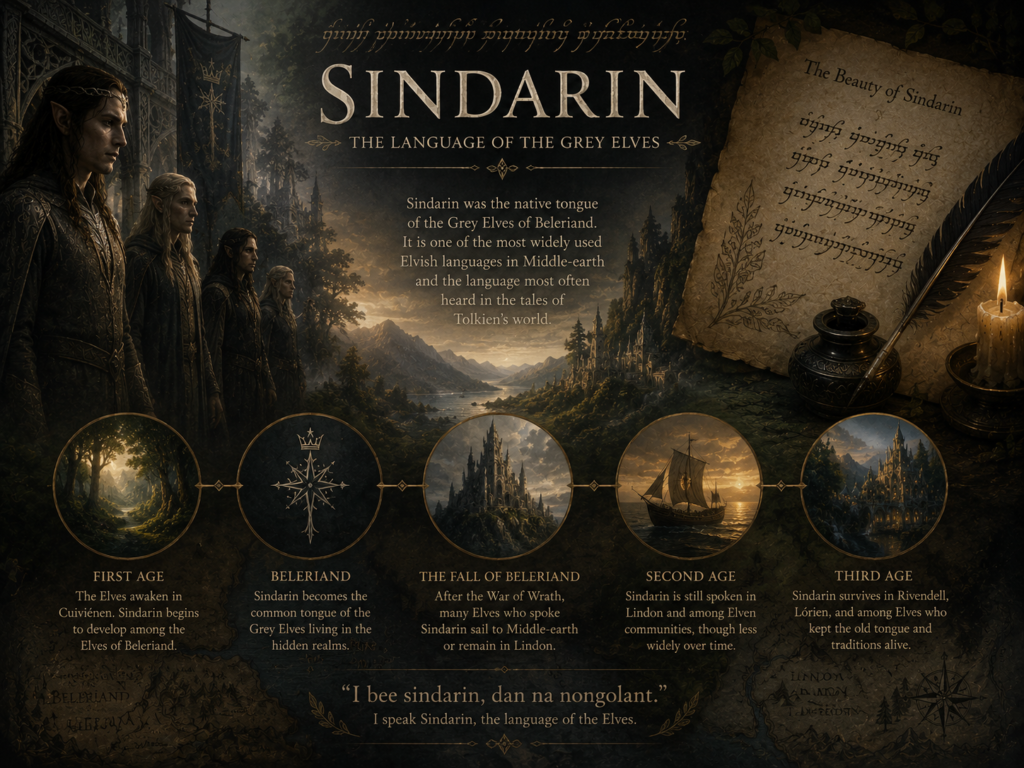
Sindarin didn’t stay fixed the way a dictionary entry does. Tolkien treated it as a living language within his fictional timeline, meaning it changed the way real languages change: through migration, regional isolation, and centuries of everyday use. Early forms of Sindarin, spoken in the First Age among the Grey Elves who remained in Beleriand, differed noticeably from the version heard by the time of The Lord of the Rings thousands of years later. Sound shifts accumulated. Grammar simplified in places and grew more complex in others. Regional dialects emerged as Elvish communities spread and settled in different parts of Middle-earth.
This matters for translation because a modern Sindarin translator, including this one, has to pick a consistent point in that evolution to work from. Most tools, ours included, base their vocabulary and grammar on the most widely documented and broadly accepted form of Sindarin, generally reflecting the language as it existed around the Third Age, the era of the main story. Tolkien scholars have spent decades cataloging these shifts using his notes and drafts, and that ongoing scholarship is exactly why serious Sindarin translation keeps improving over time rather than staying static.
How to Use the Sindarin Translator
Getting a reliable result from any Sindarin translator comes down to a few simple habits, regardless of what you’re translating it for.
Sindarin generally lacks direct equivalents for modern concepts, so setting realistic expectations upfront saves a lot of frustration. The tool works from established vocabulary and documented grammatical patterns; highly idiomatic or very modern phrases will need interpretation rather than an exact, word-for-word match.
What to Look For in a Sindarin Translator
Not every Sindarin translator online is built the same way, and it’s worth knowing what separates a genuinely useful one from a tool that just looks convincing. A good translator should let you move between English and Sindarin in both directions, rather than locking you into one path. It should draw on real, documented vocabulary rather than generating plausible-sounding nonsense, and it should tell you clearly when a word has no direct match instead of quietly filling the gap with a guess.
Beyond accuracy, ease of use matters too, a simple way to enter text, review the result, and copy it out for wherever it’s headed next, whether that’s a tattoo design, a piece of writing, or a character sheet. A library of common, pre-verified phrases is also genuinely useful, since it gives you a reliable starting point without needing to guess whether a translation is solid. What matters most, though, is honesty about limitations. Any Sindarin translator that claims perfect accuracy on every possible phrase is telling you more about its marketing than about Sindarin itself.
Common Sindarin Words and Phrases
A handful of Sindarin words and names come up constantly, both because Tolkien used them directly in his writing and because the films made them widely recognizable.
|
English |
Sindarin |
|---|---|
|
Friend (Doors of Durin password) |
Mellon |
|
Well met (greeting) |
Mae govannen |
|
You are welcome here |
Gi nathlam hí |
|
A star shines on the hour of our meeting |
Elen síla lúmenn’ omentielvo |
|
Greenleaf (Legolas) |
Legolas |
|
Kingly, noble valour (Aragorn) |
Aragorn |
|
Grey pilgrim (Gandalf’s Elvish name) |
Mithrandir |
|
Land of the blossoming gold trees |
Lothlórien |
Mellon deserves the spotlight here. It’s the word inscribed on the Doors of Durin, and the entire scene hinges on realizing that the riddle “speak, friend, and enter” isn’t a puzzle at all, it’s a direct instruction. Speaking the Sindarin word for friend opens the gate. It’s one of the clearest, most memorable examples of how Tolkien’s languages function as real, working systems inside his stories, not just decoration.
Sindarin in Peter Jackson’s Films and Beyond
Sindarin’s reach goes well beyond the books themselves. Peter Jackson’s Lord of the Rings and Hobbit trilogies are where most people first hear the language spoken aloud, thanks to David Salo’s work turning Tolkien’s grammatical notes into performable dialogue for actors. Video games built around Middle-earth regularly use Sindarin for character names, quest text, and environmental details, and tabletop games.
Even original Dungeons & Dragons campaigns set in similar high-fantasy worlds, often borrow Sindarin-style naming conventions to give locations and characters an authentic, Tolkien-inspired feel. Even real-world place names within the stories carry Sindarin roots; Mirkwood itself traces back to Sindarin word-formation, a small detail that rewards readers who know what to listen for.
This crossover into games and media is a big part of why interest in a Sindarin translator keeps growing rather than fading. Every new adaptation, whether a film, a game, or a television series, introduces the language to another wave of fans looking to understand or use it themselves.
Learning Sindarin Through Translation
Using a Sindarin translator regularly turns out to be a surprisingly effective way to start actually learning the language, not just borrowing from it. Beginners generally get the most out of starting with common greetings, simple nouns, and short verbs, translating them repeatedly until the words start to stick without needing to look them up each time. From there, comparing a handful of related phrases side by side, like Mae govannen and Gi nathlam hí, helps reveal small grammatical patterns that a single word never shows on its own.
More advanced learners tend to move toward longer or more complex sentences, testing how Sindarin grammar handles tense, mood, and consonant mutation in less predictable contexts. Translation works well here too, less as a shortcut and more as a way to check your own instincts against documented vocabulary. If you want a more structured approach, our guides on how to pronounce Elvish words correctly and a realistic study plan for learning Elvish go into far more depth than a translation tool alone ever could.
Who Uses a Sindarin Translator
People come to a Sindarin translator from a few distinct directions. Tattoo seekers often want short, meaningful phrases like Mellon or a personal name rendered in Tengwar, precisely because Sindarin’s grounded, everyday tone suits something personal. Writers and game masters building original fantasy worlds or D&D campaigns frequently want character and place names that sound authentically Tolkien rather than invented from scratch, and documented Sindarin roots do that job far better than a random name generator
Cosplayers and fan artists look for recognizable lines and greetings to bring into costumes, artwork, or conventions. And language learners curious about how a constructed language actually works often start here, using translation as a way to build vocabulary before moving into fuller grammar study.
Whatever the reason, the same rule holds across every use case: short, well-documented phrases translate far more reliably than long or modern-sounding ones.
How Accurate Is This Sindarin Translator?
This deserves a direct answer, not a marketing one. This Sindarin Translator performs best with short, documented words, names, and well-known phrases drawn from Tolkien’s own published writing and linguistic notes. When a clear Sindarin equivalent exists, we show it and explain the reasoning. When it doesn’t, we say so plainly instead of generating something that merely sounds convincing.
Tolkien’s Elvish languages were never built as fully modern languages with comprehensive dictionaries covering every possible expression. He built them primarily as a literary and linguistic project, focused on sound, history, and internal consistency rather than practical, everyday coverage. That means a direct, word-for-word Sindarin translation isn’t always possible or linguistically authentic for every English phrase you might want to translate, and any tool claiming otherwise is overselling what’s actually achievable.
Limitations of Sindarin Translation
Sindarin’s vocabulary has genuine, well-documented gaps, and any honest Sindarin translator should be upfront about that. There’s no historical Sindarin word for modern concepts like “internet” or “airplane,” since Tolkien built this language to exist within a specific fictional history, not to describe the present day. Complex or highly idiomatic English sentences often don’t carry over cleanly and require interpretation rather than an exact match. Some grammatical questions remain genuinely debated among Tolkien linguists today, since his own notes on Sindarin evolved and shifted across decades of private revision, sometimes contradicting earlier drafts.
No Sindarin translator, ours included, should be treated as a final, unquestionable authority, particularly for anything permanent like a tattoo or engraving. A quick cross-check against a second source before committing to anything lasting is always worth the extra few minutes.