
English to Quenya Translator – Tolkien’s High Elvish Language from Lord of the Rings
Quenya is the oldest and most formal of Tolkien’s Elvish languages, and our Quenya Translator exists to help you use it correctly. Type in a name, a greeting, or a short phrase, and this tool converts your English into documented Quenya vocabulary, then shows the result in Tengwar script so you can see how it would actually look written down.
Most tools that promise a Quenya translation are really just decorating English letters with Elvish-style shapes. That’s not translation, and it isn’t Quenya either. What you get here draws from Tolkien’s own linguistic notes, tells you plainly when a word has no documented equivalent, and never dresses up a guess as a fact.

What Is Quenya?
Quenya is often called High Elvish, and that name says a lot about how Tolkien used it. Within Middle-earth, Quenya isn’t the language Elves spoke over dinner; it’s the formal, ceremonial tongue reserved for song, ancient lore, and ritual, closer in role to how Latin functioned in medieval Europe than to any everyday spoken language. Sindarin filled that everyday role instead, which is why most dialogue in The Lord of the Rings is actually Sindarin, not Quenya.
Tolkien built Quenya’s sound and grammar around Finnish, a language he encountered as an Oxford student and later described as feeling like discovering an entire wine cellar full of bottles he’d never tasted. That influence shows up everywhere: long vowels, a musical rhythm, few harsh consonant clusters, and one of the most detailed grammar systems Tolkien ever built, including ten separate noun cases that shift a word’s ending depending on its role in a sentence. No other language Tolkien invented received this much grammatical attention, which is part of why serious Elvish scholarship treats Quenya as the closest thing to a genuinely learnable Tolkien conlang.
Some of Quenya’s most famous lines come directly from the books themselves. Galadriel’s lament, Namárië, remains the longest published piece of continuous Quenya text Tolkien ever wrote, and it’s still one of the first things new learners study.
How to Use the Quenya Translator
Quenya rewards short, deliberate phrasing far more than long, casual sentences, so getting a result you can trust from a Quenya translator starts with keeping a few things in mind.
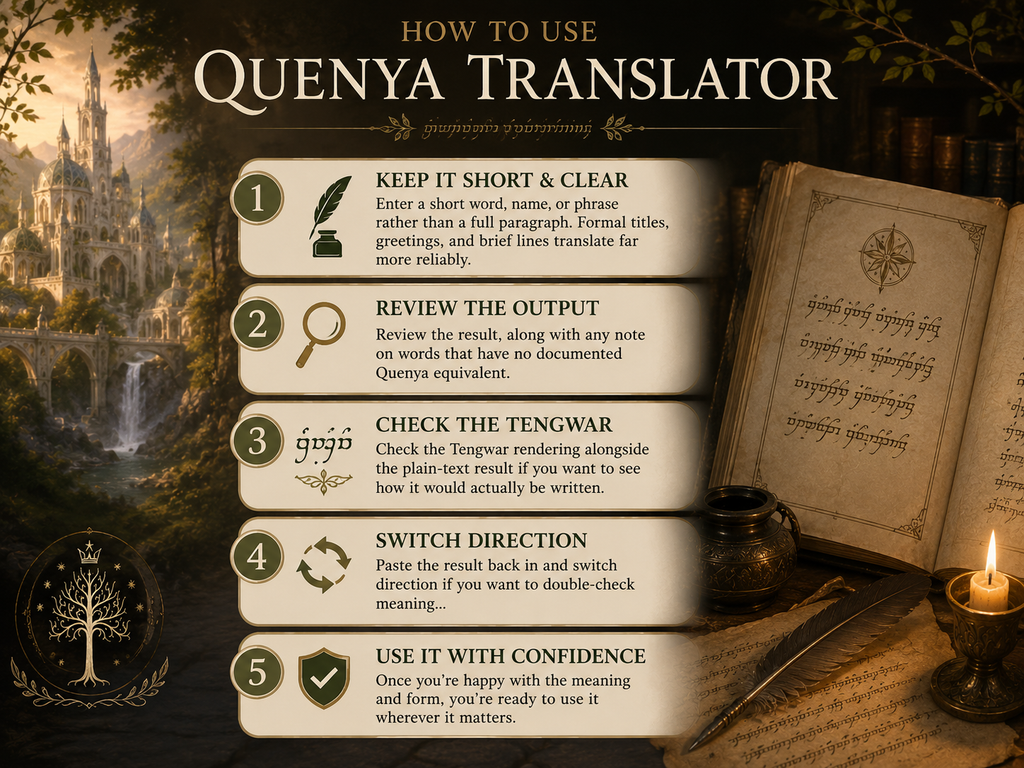
Because Quenya carries a formal register by nature, it tends to suit ceremonial titles, blessings, and short poetic lines better than casual conversation. If your phrase feels more everyday or personal in tone, it may actually belong in Sindarin instead, which brings us to the choice most people have to make before translating anything at all.
Quenya vs Sindarin: Why the Choice Matters
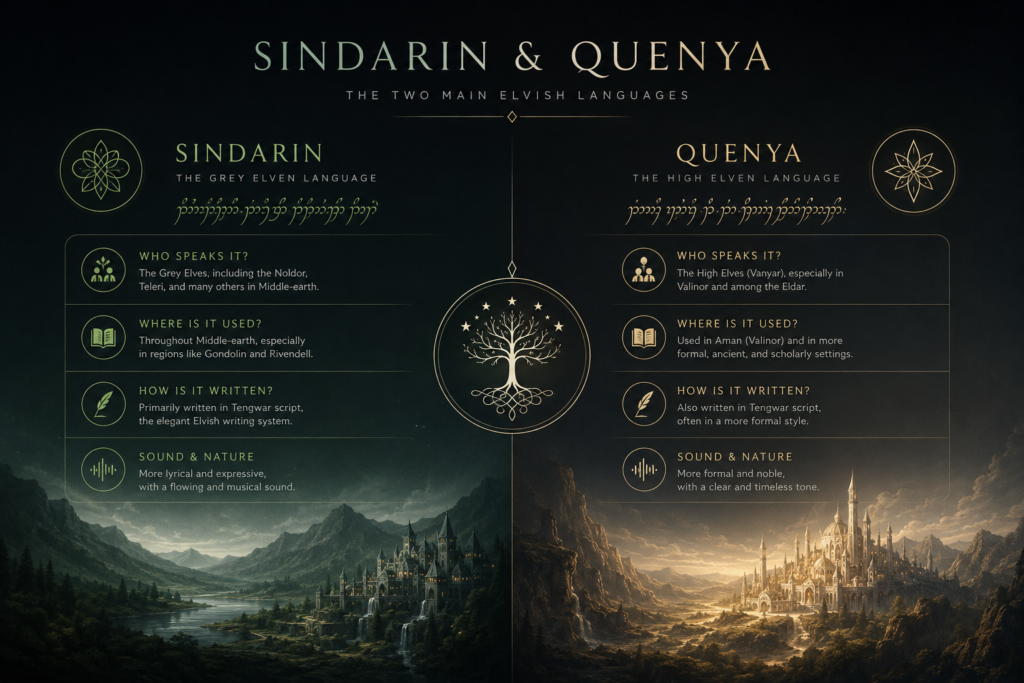
Every Quenya translation decision really starts with a language decision. Quenya and Sindarin are both genuinely Elvish, but they serve different purposes within Tolkien’s world, and mixing them into a single phrase produces something a fluent reader of either would immediately flag as inconsistent.
Quenya carries weight and formality; it’s the language of oaths, songs, and old lore. Sindarin feels warmer and closer to everyday speech, since it was the language Elves actually used to talk to one another in Middle-earth. If you’re translating a formal title, a wedding blessing, or a line meant to sound ancient, Quenya is usually the right call.
If you want something conversational or personal, our dedicated Sindarin Translator is likely a better fit, and our full Sindarin vs Quenya guide breaks down the grammar and tone differences in far more depth than a quick translation tool can. For a broader view that covers both languages side by side, our main Elvish Translator page is built exactly for that comparison.
Quenya Translation Examples
Seeing full phrases translated helps more than a word list alone, especially since Quenya’s grammar shifts word endings depending on context.
|
English |
Quenya |
|---|---|
|
A star shines on the hour of our meeting |
Elen síla lúmenn’ omentielvo |
|
Farewell |
Namárië |
|
Hail |
Aiya |
|
Good day |
Mára aurë |
|
My friend sees light |
Meldë cenë calë |
|
The star shines |
Elen síla |
Short, self-contained lines like these translate cleanly because Tolkien documented them directly or built clear grammatical patterns around similar phrases. Longer, modern-sounding sentences are far more likely to hit vocabulary gaps.
Common Quenya Words and Phrases
A handful of Quenya words show up constantly in translations, tattoos, and fan writing, largely because Tolkien used them repeatedly across his own work.
|
English |
Quenya |
|---|---|
|
Hello / hail |
Aiya |
|
Farewell |
Namárië |
|
Friend |
Meldë |
|
Love |
Méla |
|
Light |
Calë |
|
Star |
Elen |
|
King |
Aran |
|
Peace |
Sérë |
Aiya and Namárië are the two words most people recognize on sight, largely thanks to their appearances in the books and films. If you’re translating something for the first time, either one is a solid, well-documented place to start.
Who Uses a Quenya Translator
People come to a Quenya translator from a few genuinely different directions. Fans wanting a Quenya tattoo often gravitate toward short, weighty lines like Namárië or Elen síla, precisely because Quenya’s formal tone suits something meant to last. Others come looking for name translation, hoping to find a High Elvish form of their own name, or a character’s name, for a piece of jewelry, an engraving, or a fantasy story. Writers building original fiction or tabletop campaigns often want vocabulary that sounds authentically Tolkien rather than invented, which is exactly where documented Quenya roots do more work than a random name generator ever could.
There’s also a smaller, more dedicated group: fans who’ve already learned some Sindarin and want to go further into Tolkien’s more formal, older dialect. This is where things get genuinely academic. Quenya has the most thoroughly documented grammar of any language Tolkien built, published across journals like Vinyar Tengwar and Parma Eldalamberon, which compile his posthumous linguistic notes for serious study. If you’re at that stage, a Quenya translator like this one is a useful starting point, not a replacement for that deeper research.
How Accurate Is This Quenya Translator?
This deserves the same honest answer we give on every page of this site. This Quenya Translator performs best with short, documented words, names, and well-known phrases drawn from Tolkien’s published writing and linguistic notes. When a word has a clear Quenya equivalent, we show it and explain why. When it doesn’t, we say so.
Quenya’s grammar is genuinely complex, ten noun cases, layered verb conjugations, and sound patterns borrowed from Finnish, and no automated tool captures every nuance of that system perfectly. A translator claiming otherwise is overselling what any Elvish tool, including ours, can actually do. What we can promise is transparency: you’ll always know which words are solidly documented and which ones involved some interpretation.
Limitations of Quenya Translation
Quenya’s vocabulary, while more extensively documented than Sindarin’s, still has real gaps, and any honest Quenya translator should say so upfront. There’s no historical Quenya word for modern concepts like “computer” or “email,” because Tolkien built this language for a specific fictional history, not contemporary use. Some grammar points remain debated among Tolkien linguists, since his own notes evolved and sometimes contradicted themselves across decades of private revision. Longer or idiomatic English sentences often don’t have a clean Quenya equivalent, and any translation of one requires interpretation rather than a direct, verifiable match.
No single Quenya translator, including this one, should be treated as a final authority, especially for anything permanent like a tattoo. Cross-checking short phrases against a second source is always worth the extra few minutes.