
Tengwar Script: The Complete History and How It Works
The Tengwar script is the writing system J.R.R. Tolkien built for Middle-earth, and it’s a far deeper piece of design than most people realize the first time they see it. It isn’t a random collection of pretty symbols. It’s a genuinely engineered alphabet, built by a professional philologist who spent decades refining how letter shapes could reflect the actual sounds they represent.
This page goes past the basics. If you’re looking for a quick primer on how to read individual letters, our Tengwar Alphabet Explained guide covers that ground. Here, we’re going deeper: where the script actually came from, how its different modes work, where it shows up in real Tolkien history, and a few technical details even longtime fans often don’t know.
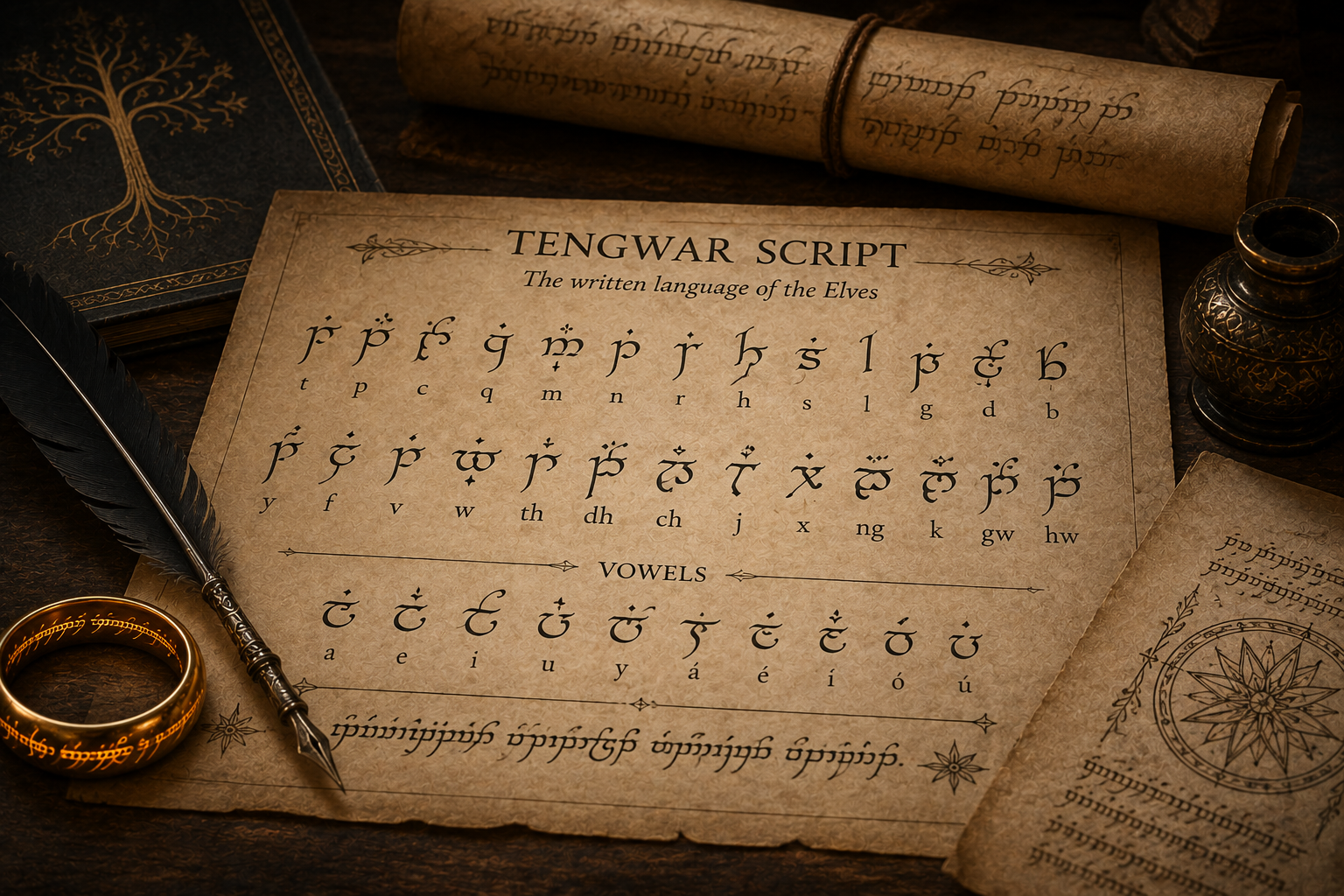
The History and Origins of the Tengwar Script
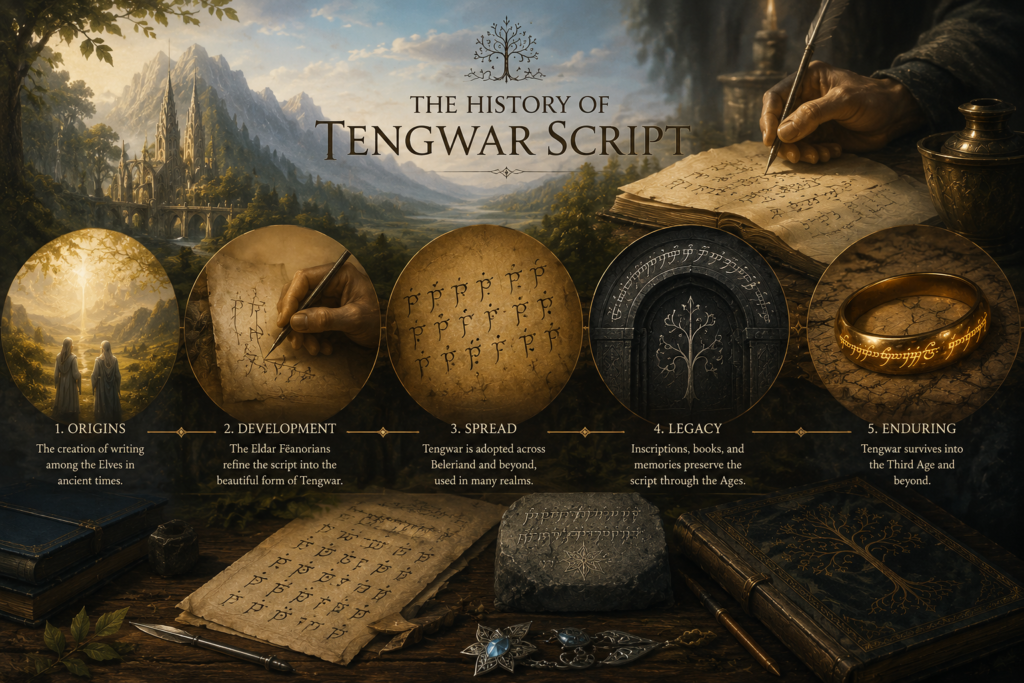
Tengwar didn’t appear fully formed. Tolkien’s first attempt at an Elvish writing system was called Sarati, developed in the late 1910s and credited within his mythology to the loremaster Rúmil of Valinor. Sarati already had several ideas that would carry forward: vowels shown through diacritic marks rather than full letters, and a loose connection between a letter’s shape and the sound it made.
Between roughly 1922 and 1925, Tolkien refined this further into something he called the Valmaric script, which brought in more of the letter shapes and structural ideas that would define Tengwar itself. This proper form likely emerged in the late 1920s or early 1930s, developed gradually rather than invented in a single burst. Within his fiction, Tolkien credited its creation to Fëanor, the brilliant and ultimately tragic Elvish loremaster, framing Tengwar as a refinement of Rúmil’s earlier Sarati.
The first Tengwar sample Tolkien actually published appeared in 1937, in the earliest editions of The Hobbit, a short inscription on a jar illustration referencing the Lonely Mountain. It would take almost twenty more years for a full explanation of the script to reach readers, arriving in Appendix E of The Return of the King in 1955. That gap says something about how Tolkien worked: the language and script existed as a private, evolving project long before most of it ever reached the public.
How the Tengwar Script Actually Works
Tengwar is what linguists call a featural writing system, meaning the shape of a letter isn’t arbitrary; it’s built to reflect features of the sound it represents. Every tengwa, the term for an individual letter, is built from two basic parts: a stem called a telco and a bow-shaped element called a lúva. The telco can be short or tall, and the lúva can be single or doubled, open or closed. Combine those variations and you get roughly thirty to forty distinct letter shapes, each one carrying real phonetic information in its form rather than being memorized as a random symbol.
Consonant letters are organized into a grid: columns, called témar, group letters by where in the mouth a sound is produced, while rows, called tyeller, group them by how the sound is produced, voiced, voiceless, nasal, and so on. Vowels are usually written as small diacritic marks called tehtar, placed above or below a consonant rather than as separate standalone letters. This structure is a big part of why people who study Tengwar closely tend to describe it as unusually elegant for an invented script; the system genuinely rewards understanding the pattern rather than brute memorization.
Tengwar Script Modes for Different Languages
One of the most important things to understand about the Tengwar script is that it isn’t locked to a single language. Tolkien designed it as a flexible system that could represent Quenya, Sindarin, and even English, and each of these applications follows its own set of conventions, called a mode.
The Quenya mode places vowel tehtar over the consonant that precedes them. The Sindarin mode, sometimes called the mode of Beleriand or the Gondor mode, places those same tehtar over the following consonant instead, a small but meaningful difference that changes how a transcribed word actually looks.
English can be written in Tengwar too, using what’s generally called the Common Mode, a convention developed largely by fans over the decades since Tolkien’s death rather than fully specified by Tolkien himself. Interestingly, the Common Mode tends to mirror English spelling more than English pronunciation, which is part of why two people transcribing the same English word don’t always produce identical results.
Modes are also split into two broader categories: Full Modes, which write vowels as distinct tengwar rather than diacritics, and Ómatehtar Modes, which use the tehtar system described earlier. Knowing which category and which specific mode you’re looking at is often the key to understanding why two Tengwar samples of the same word can look meaningfully different from each other.
Real Historical Examples of the Tengwar Script
A handful of genuine inscriptions from Tolkien’s published work show this writing system in action, and they’re worth knowing beyond just “Elvish writing looks cool.”
The inscription on the One Ring itself, the fiery Black Speech verse beginning “Ash nazg durbatulûk,” is written in Tengwar letters, even though the language being written isn’t Elvish at all, a clear demonstration that Tengwar is a script capable of representing multiple languages, not a language itself. The Doors of Durin carry a Sindarin inscription in Tengwar, built around the famous riddle that opens with the word for friend.
The Book of Mazarbul, discovered in the ruins of Moria, is written largely in Tengwar as well, its damaged pages recording the fall of the Dwarves who once held the mines. Even the title page of The Lord of the Rings carries a Tengwar inscription, easy to miss on a first read but genuinely there, describing the book’s origin as the Red Book of Westmarch.
Is the Tengwar Script in Unicode?
Here’s a technical detail most casual guides skip entirely: the Tengwar script still doesn’t have official Unicode support. There’s an unofficial, community-agreed codepage that most Tengwar fonts follow, which lets digital tools display the script consistently enough for practical use, but it hasn’t been formally standardized. Part of the reason is that Tolkien’s own notes on the script are still being studied; new source material continues to surface from the Tolkien Estate’s archives, meaning the exact character set and its finer details remain something of a moving target even decades after his death.
Tengwar Fonts and Digital Tools
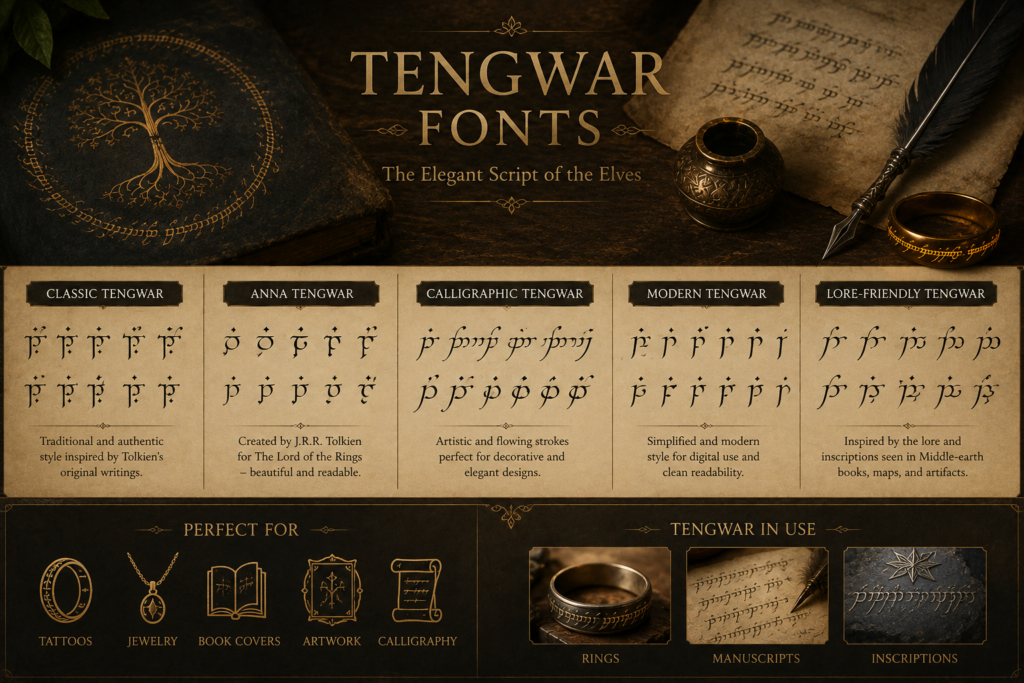
Because Tengwar predates digital typography by decades, using it on a modern screen depends entirely on dedicated fonts built by fans and typographers. Tengwar Annatar is probably the most widely used free option, designed to closely match the flowing, calligraphic style seen in Tolkien’s own handwriting samples. More specialized fonts, like Alcarin Tengwar, push further into calligraphic detail, drawing inspiration from medieval Latin styles like Insular and Carolingian minuscule, the same broad tradition of handwriting that likely shaped how Tolkien himself approached the script’s aesthetics.
For anyone working in academic or technical typesetting, there’s even a dedicated LaTeX package supporting multiple Tengwar font families, a small but telling sign of how seriously some corners of the fan community take getting the script exactly right.
How the Tengwar Script Compares to Other Fictional Writing Systems
It’s worth putting Tengwar’s design in context. Plenty of fictional scripts from other franchises, Klingon from Star Trek or Aurebesh from Star Wars among them, are built heavily on existing alphabets, often mapping new symbols onto a familiar Latin letter-by-letter structure. Tengwar takes a fundamentally different approach. Its featural design, where letter shape actually encodes phonetic information, has no real equivalent among major fictional scripts, and few real-world writing systems work quite this way either. That’s a large part of why Tengwar continues to attract serious linguistic interest decades after its creation, rather than fading into being just another fantasy prop.
Learning to Read and Write the Tengwar Script
Once the history and structure click into place, actually learning to read and write Tengwar becomes far more approachable than it looks at first glance. Start with the basic consonant groupings and their témar and tyeller pattern before worrying about every mode’s specific quirks. Our Tengwar Alphabet Explained guide walks through that foundation step by step, and our Tengwar Alphabet Translator lets you see real conversions in action, which is often the fastest way to notice these patterns for yourself rather than memorizing them from a chart alone. If you’re also curious about the separate angular runic system Tolkien built alongside Tengwar, our Cirth Translator covers that script in the same depth.