Cirth Translator: English to Dwarf Runes (Tolkien’s LOTR)
Our Cirth Translator converts your English text into Cirth, the angular runic script J.R.R. Tolkien built for Middle-earth. Type in a name, a phrase, or a short inscription, and you’ll see it rendered in genuine Cirth runes, following the actual letter-shape rules Tolkien laid out rather than a generic set of real-world runes borrowed to look the part.
That last point matters more than it sounds. Where Tengwar flows like ink across a page, Cirth was built to be cut into stone, wood, and metal, and it carries a completely different visual identity as a result. A lot of tools calling themselves a Cirth translator actually just reuse real-world Elder Futhark runes, since they look vaguely similar. They aren’t the same alphabet, and a reader who actually knows Cirth will spot the substitution immediately.
What Is Cirth?
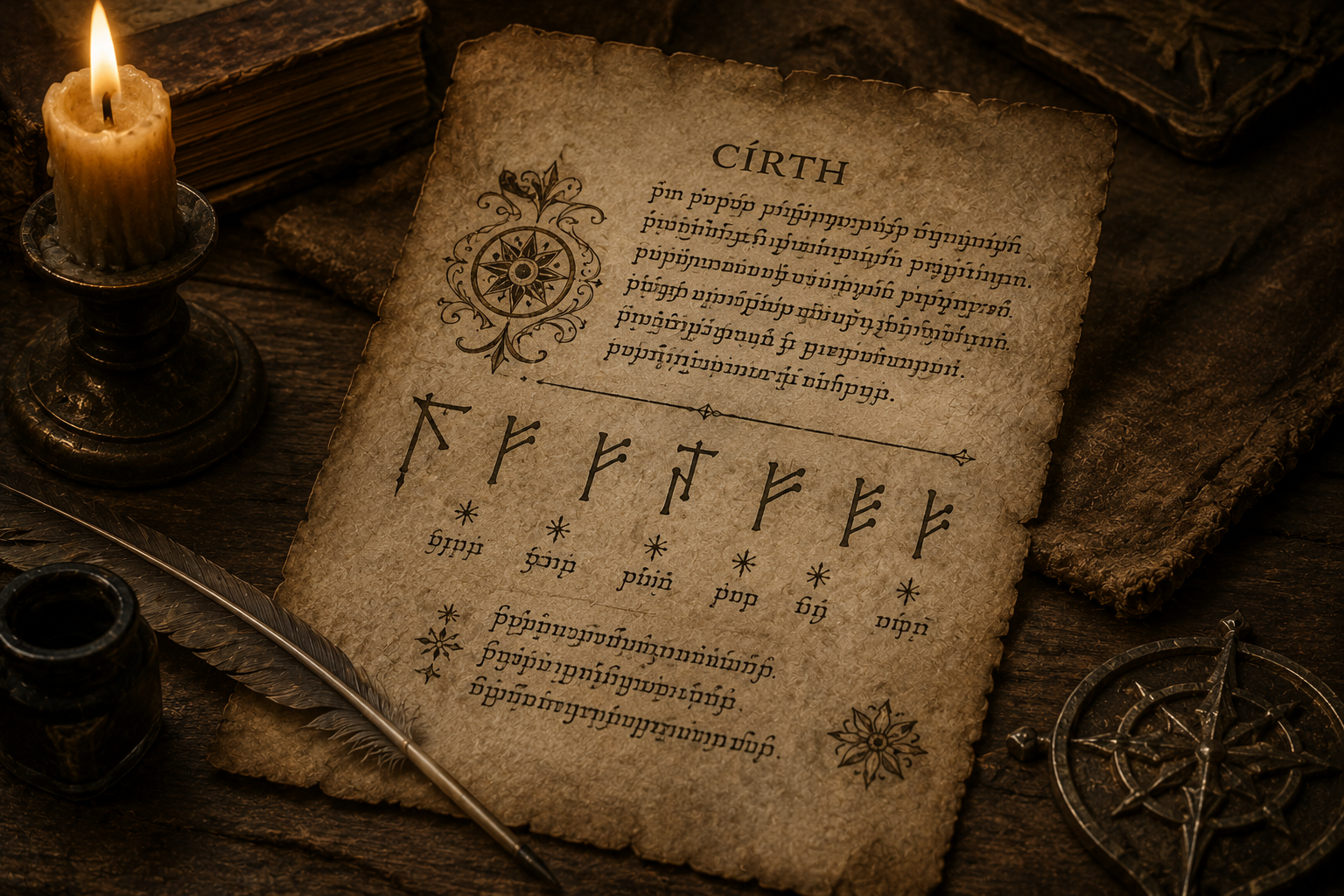
Cirth means “runes” in Sindarin, and a single letter is called a certh. Unlike Tengwar, which Tolkien designed as a flowing, calligraphic script, Cirth was built from the start for carving. Its straight lines and angular shapes exist because cutting a curve into stone or wood is far harder than cutting a straight stroke, the same practical reason real-world runic alphabets like the Elder Futhark ended up looking the way they do.
Within Tolkien’s mythology, Cirth was invented by the Sindar, the Grey Elves of Beleriand, for writing their own language, Sindarin. It was meant mainly for short, practical purposes: inscribing names, memorials, and brief labels on solid materials rather than long passages of text. That’s a big part of why Cirth inscriptions in the books tend to be short and monumental, a name on a tomb, a password on a gate, rather than pages of flowing prose.
Cirth, Certar, Angerthas: A Script With Many Names
If you’ve seen this runic system called several different things, that’s not a mistake; it genuinely goes by multiple names depending on which version and which language you’re talking about. In Quenya, the same script is called Certar, with a single rune called a certa. The original, simpler Elvish version was known as the Certhas, meaning something close to “rune-row.”
When the Elf-loremaster Daeron reorganized and expanded that original system, adding a more systematic logic to how sounds were assigned to shapes, it became known as the Angerthas Daeron, meaning “long rune-rows.” This is the version most fans mean when they casually say “Cirth.” Later, when the Dwarves adopted the system for their own language, Khuzdul, they modified it further into the Angerthas Moria. When some of those Dwarves resettled in Erebor and needed a script for trading with Men, they adapted it again into the Angerthas Erebor, which was also used to write Westron, the common tongue Tolkien renders as English throughout his books.
So “Dwarvish runes,” a term you’ll see used constantly online, is really only accurate for the Moria and Erebor versions. The original system was Elvish, not Dwarvish at all, and understanding that lineage helps make sense of why different Cirth charts you might find online don’t always match each other exactly.
Famous Cirth Inscriptions in Tolkien’s Work
A handful of real inscriptions from Tolkien’s writing show Cirth in action, and recognizing them helps separate genuine Cirth from a generic runic font.
Balin’s tomb in the Chamber of Mazarbul carries perhaps the most famous Cirth inscription in the entire legendarium, a grim epitaph the Fellowship discovers deep in Moria. The Book of Mazarbul itself, the damaged, blood-stained record found nearby, is also written largely in Angerthas Moria, documenting the fall of the Dwarves who tried to reclaim the mines. Even the title page of The Lord of the Rings carries a Cirth inscription, written in Angerthas Erebor, spelling out an English sentence about the Red Book of Westmarch in runic form, paired with a matching Tengwar inscription below it.
One correction worth making clearly: the runes on Thror’s Map in The Hobbit are not Cirth at all. They’re real-world Anglo-Saxon Futhorc runes that Tolkien adapted to write Modern English, a completely separate runic tradition he used specifically for that map and a few similar pieces. It’s an easy mix-up, since both systems look angular and rune-like at a glance, but they’re genuinely different alphabets with different histories, both inside and outside the story.
Cirth vs Tengwar: Two Different Scripts
Cirth and Tengwar are both genuinely Elvish in origin, but they were built for different jobs and look nothing alike once you know what to look for. Tengwar’s curved, flowing letterforms suit pen and ink, and it became the dominant script for formal writing, books, and correspondence across most of Middle-earth by the Third Age. Cirth’s straight, angular strokes suit carving, and it survived mainly in inscriptions, monuments, and the specific cultural context of the Dwarves, who kept using and adapting it long after most Elves had moved on to Tengwar.
Neither script is more “authentically Elvish” than the other; they simply reflect different tools and different purposes. If you’re after the flowing calligraphic look most people picture first when they hear “Elvish writing,” our Tengwar Alphabet Translator covers that script in full depth instead.
How to Use the Cirth Translator
Getting a clean, accurate result from this Cirth translator comes down to a few simple habits.
Because most modern devices don’t have Cirth built into standard fonts, results are often best saved as an image rather than plain text, especially if accuracy in how the runes actually display matters for your project.
Cirth in Tattoos, Games, and Fan Culture
Cirth has a smaller but genuinely dedicated following compared to Tengwar, largely because its angular, carved aesthetic appeals to a specific kind of design, tattoos, jewelry, and game props meant to look forged or engraved rather than written. Tabletop games and video games set in Middle-earth-inspired worlds often borrow Cirth-style runes for weapons, doors, and ancient inscriptions, leaning on that “cut into stone” visual identity Tolkien built into the script from the start. Fan communities maintain detailed reference charts distinguishing the Daeron, Moria, and Erebor variants specifically to help people avoid mixing up letter values between them, a mistake that’s easy to make given how many versions exist.
Who Uses a Cirth Translator
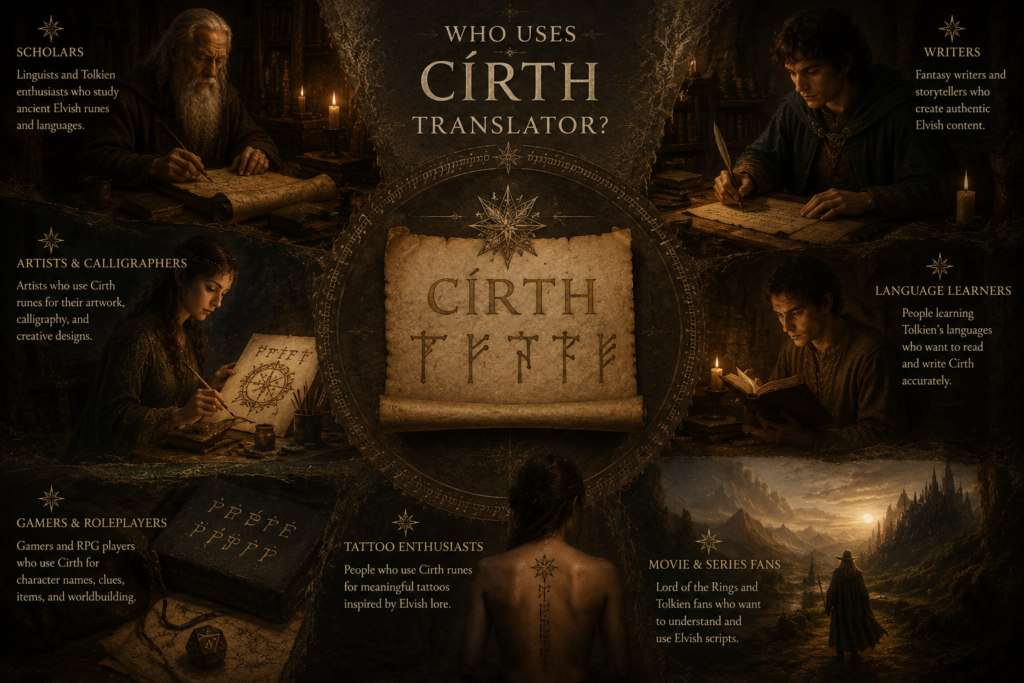
People come to a Cirth translator for a few distinct reasons. Tattoo and jewelry seekers want short, verifiable inscriptions with that distinct carved, runic look, often referencing Balin’s tomb as a real, well-documented example. Game designers and writers building Dwarvish or dungeon-themed content look for authentic-feeling runes for props, maps, and environmental details. Cosplayers and prop-makers recreate specific book or film inscriptions for costumes and replicas. And Tolkien linguistics enthusiasts use a Cirth translator to explore how the script actually works, often as a way to understand the relationship between Cirth and Tengwar more concretely than a description alone provides.
How Accurate Is This Cirth Translator?
This deserves the same honest answer we give across every page on this site. This Cirth translator works from documented rune values drawn from Tolkien’s own notes in Appendix E of The Return of the King, along with published scholarship on the script’s variants. Because multiple versions of Cirth exist, Daeron, Moria, and Erebor, with genuinely different letter assignments in places, we default to the most widely referenced version and note where meaningful variation exists rather than presenting one version as the single universal answer.
Cirth was designed primarily for short inscriptions, not full modern sentences, so longer or more complex text naturally involves more interpretation than a short name or phrase would. A tool that claims flawless, unambiguous accuracy across every possible input is overselling what any Cirth translator, including this one, can realistically deliver.
Limitations of Cirth Translation
A few honest limitations are worth knowing before relying on this Cirth translator for anything important. Because Cirth exists in multiple documented variants, a small number of runes carry different values depending on whether you’re working from Angerthas Daeron, Moria, or Erebor, and a translation that’s accurate in one version may not match another exactly. Cirth’s vocabulary and use, like all of Tolkien’s scripts, was built for a specific fictional history, not for representing modern concepts, so unusual or highly modern words may require creative interpretation rather than a direct, verified match. And because most devices lack native Cirth font support, on-screen display can vary unless the result is exported as an image.
No Cirth translator, ours included, should be treated as a final, unquestionable authority, particularly for anything permanent like a tattoo. Cross-checking a short inscription against a documented source, such as the Balin’s Tomb text, is always worth the extra few minutes.