Tengwar Alphabet Translator: English to Elvish Script (LOTR)
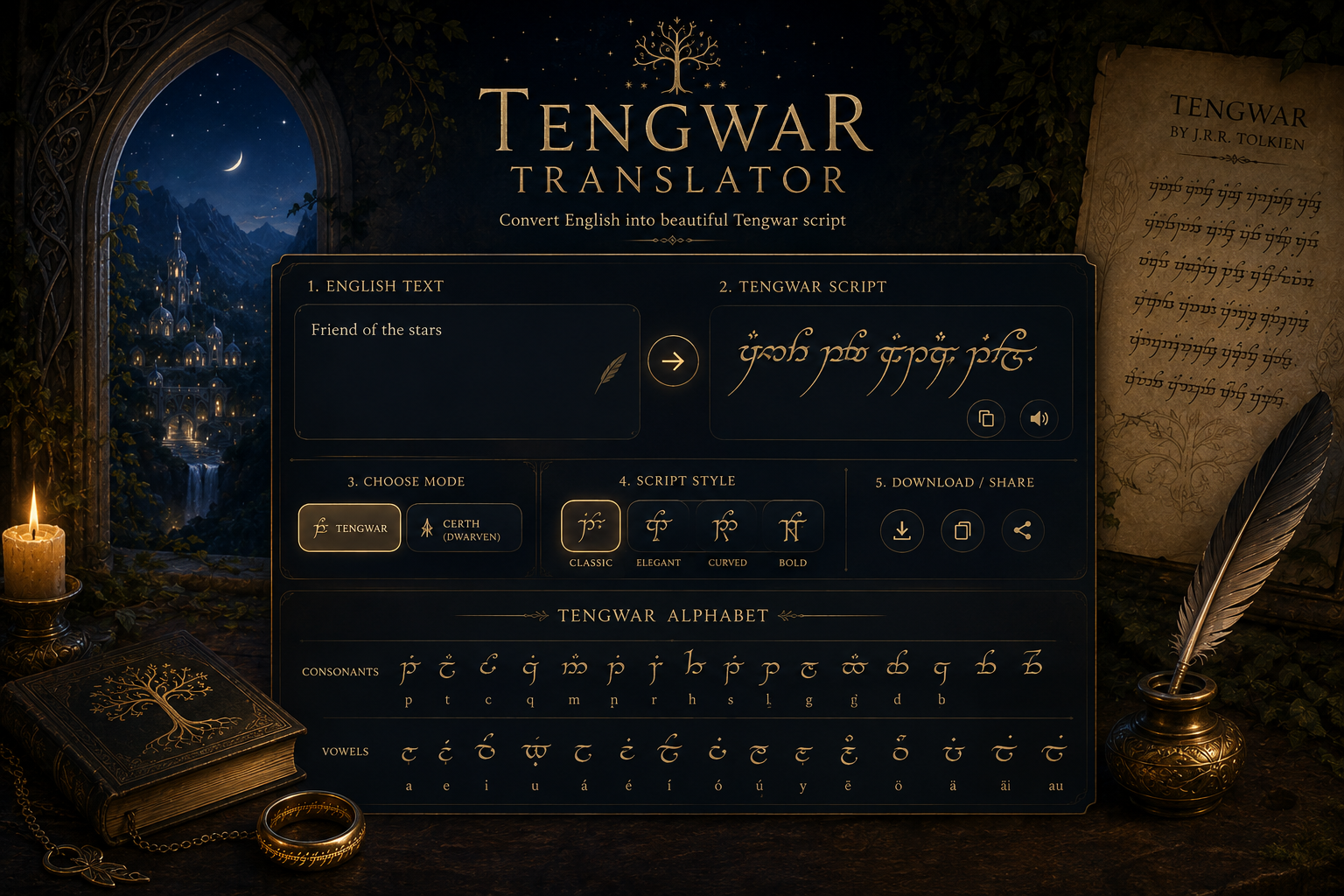
Our Tengwar Alphabet Translator converts your English text into Tengwar, the flowing writing system J.R.R. Tolkien built for Middle-earth. Type in a name, a phrase, or a line from the books, and you’ll see it rendered using the real Tengwar alphabet, following the same letter-and-diacritic rules Tolkien actually designed rather than a made-up decorative font.
That distinction matters more than most people realize going in, because Tengwar isn’t a language at all. It’s a writing system, an alphabet in the broadest sense, and mixing that up with the languages it writes, Sindarin and Quenya, is one of the most common misunderstandings around Elvish content online. Get that distinction right first, and everything else about using this tool makes a lot more sense.
What Is the Tengwar Alphabet?
The Tengwar alphabet is the elegant, curved script most people picture the moment someone says “Elvish writing.” Tolkien designed it as a phonetic writing system, meaning the shape of each letter is tied to the sound it represents, not to a fixed word or a random decorative flourish. Within his mythology, Tengwar was invented by the Elvish loremaster Fëanor during the First Age, long before the events of The Lord of the Rings, and it went on to become the dominant writing system across nearly the whole of Middle-earth.
Here’s the part that trips up a lot of casual fans: Tengwar itself isn’t Sindarin, and it isn’t Quenya either. It’s closer to how the Latin alphabet works for English, French, and Spanish all at once, the same basic letterforms, applied differently depending on which language is being written. Tolkien used Tengwar to write Quenya, Sindarin, and even English itself, and each of these applications follows its own specific set of rules, which Tolkien called a mode.
Tolkien and the Art of Language-Making
Understanding Tengwar means understanding a bit about the man who built it. Tolkien began inventing private languages as a teenager, long before Middle-earth existed as a setting for any story. By the time he reached Oxford, he was a professional philologist, a scholar of historical language change, and that academic background shows up directly in how carefully Tengwar was constructed. He once said his mythology existed largely to give his invented languages a place to live, and Tengwar, alongside the separate runic system called Cirth, was part of that same lifelong linguistic project.
This isn’t a script slapped together for visual flair. Tengwar reflects real, internally consistent design choices a working linguist would recognize, and that consistency is exactly why it still rewards close study today, nearly a century after Tolkien first sketched it out.
Tengwar Alphabet Structure: Tengwa, Tehtar, and Modes
The Tengwar alphabet works differently from an alphabet like English’s, and understanding a few key terms makes the whole system click into place.
Each individual letter is called a tengwa, and most tengwar represent consonant sounds rather than a fixed letter the way “B” or “T” work in English. Vowels aren’t separate letters at all. Instead, they’re written as small marks called tehtar, placed above or below a consonant to show which vowel sound follows it. Tolkien organized the consonant letters into a logical grid: columns called témar represent where in the mouth a sound is produced, while rows called tyeller represent how it’s produced, voiced, voiceless, nasal, and so on. That means related sounds share related letter shapes, a genuinely elegant piece of design once you see the pattern.
On top of that structure sits the concept of a mode, the specific set of rules for applying Tengwar to a particular language. Quenya mode places tehtar on the preceding consonant. Sindarin mode, sometimes called Beleriandic mode, places them on the following consonant instead. There’s also a well-documented English mode, developed by Tolkien and later refined by fans, that lets you write ordinary English words directly in Tengwar letters without translating the meaning into Elvish first. And there’s a Black Speech mode too, used for one particularly famous inscription we’ll get to shortly.
Famous Tengwar Inscriptions in Tolkien’s Work
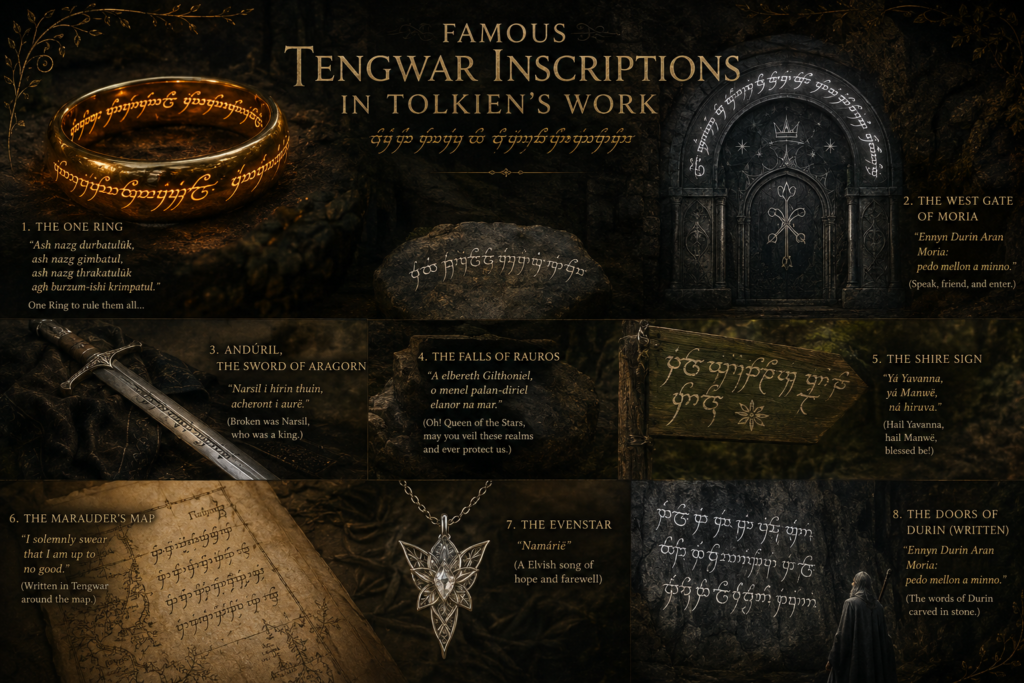
Tengwar shows up at several genuinely important moments across Tolkien’s writing, and recognizing them helps explain why the script carries so much weight with fans.
The most iconic example by far is the inscription on the One Ring itself, the fiery Black Speech verse beginning “Ash nazg durbatulûk,” written in Tengwar letters even though the language being written is the sinister tongue of Mordor, not Elvish at all. That’s actually a perfect demonstration of the point made earlier: Tengwar is a script, not a language, capable of writing even the language of the enemy using the same letterforms Fëanor designed for the Elves.
Elsewhere, Tengwar appears on the Doors of Durin, inscribed alongside the Sindarin riddle that famously reads “speak, friend, and enter.” The Book of Mazarbul, discovered in the ruins of Moria, is written in Tengwar as well, its damaged, blood-stained pages hinting at the fate of the Dwarves who once held the mines. Even the title page of The Lord of the Rings itself carries a Tengwar inscription, a detail many readers miss entirely on a first pass through the book.
How to Use the Tengwar Alphabet Translator
Getting a clean result from this Tengwar alphabet translator comes down to a few simple habits.
Because Tengwar is a script rather than a language, this Tengwar translator can render literally any English word you type. That’s genuinely different from translating into Sindarin or Quenya, where vocabulary gaps can stop a translation cold. Here, the challenge isn’t finding a matching word; it’s making sure the letters and diacritics follow the mode’s actual rules rather than a rough, letter-by-letter guess.
Tengwar in Culture: Tattoos, Calligraphy, and Fonts
Tengwar has become one of the most widely used fictional writing systems in the real world, well beyond the pages of Tolkien’s books. Tattoo studios regularly work with Tengwar designs, and dedicated fan communities maintain detailed reference guides specifically to help catch errors before they become permanent. Calligraphers are drawn to the script for its genuine visual elegance, since its logical, sound-based structure produces letterforms that flow naturally once you understand the underlying pattern.
Digital tools have made all of this far more accessible. Free Tengwar alphabet fonts, most notably one commonly called Tengwar Annatar, let anyone type in the script on an ordinary keyboard, and dedicated Tengwar keyboard layouts exist for enthusiasts who want to go further. This translator handles that conversion directly, so you don’t need a special font installed just to see an accurate result.
Who Uses a Tengwar Alphabet Translator
People turn to a Tengwar alphabet translator for a few distinct reasons. Tattoo seekers want a script rendering they can verify before committing to something permanent, often cross-referencing against known inscriptions like the Doors of Durin. Calligraphers and artists use it as a starting point for hand-lettered pieces, wedding invitations, or fan art. Writers and worldbuilders transcribe character names or short lines to add authentic visual detail to creative projects. And Tolkien fans and students of the language use it simply to explore how the script represents sounds, often as a stepping stone toward learning Sindarin or Quenya vocabulary properly. Our Tengwar Alphabet guide goes further into the mechanics for anyone in that last group.
How Accurate Is This Tengwar Alphabet Translator?
This deserves a straight answer. Because Tengwar is a writing system rather than a language, this Tengwar translator can render any English word you enter using English mode, applying tehtar and tengwar according to Tolkien’s documented conventions. Where it’s worth being careful is with English mode itself: English spelling and Elvish phonetic writing don’t always line up neatly, since Tengwar was built to represent sounds precisely, while English spelling is famously inconsistent. A tool that ignores this and does a rigid letter-by-letter substitution isn’t producing authentic Tengwar, just a decorative approximation.
For text you already have in Quenya or Sindarin, applying the correct mode in this Tengwar translator, tehtar placement on the preceding consonant for Quenya, the following consonant for Sindarin, matters just as much as getting the individual letters right. We apply these mode distinctions rather than using one generic mapping for every language, which is exactly where a lot of decorative “Elvish font” tools fall short.
Limitations of Tengwar Translation
A few honest limitations are worth knowing before you rely on any Tengwar alphabet translator for something important. English mode conversion is inherently an approximation in places, since it maps English sounds, not English spelling, onto Tengwar letters, and different fan-developed conventions for English mode exist with small variations between them. Some rarer sounds and letter combinations have more than one historically attested rendering, meaning two accurate sources can occasionally produce slightly different, equally defensible results. And because Tengwar predates widespread digital use by decades, most on-screen results still depend on a properly installed Tengwar font to display correctly outside of an image export.
None of this makes a Tengwar translator unreliable, but it does mean a tool claiming one single, universally “correct” answer for every word is overstating things. For anything permanent, like a tattoo, cross-checking your result against a well-documented source, such as the Doors of Durin inscription or a trusted Tengwar reference chart, is always worth the extra few minutes.