Elvish Words for Music and Song
Music runs through nearly every corner of Tolkien’s mythology, from the very creation of Middle-earth through the Ainulindalë, often translated as the “Music of the Ainur,” to the songs Elves sing throughout the story itself. Elvish words for music and song reflect that centrality directly, carrying some of the richest, most reverent vocabulary found in either language.
Here’s what these words mean, and why music sits at the very foundation of Tolkien’s world.
Why Music Matters So Much in Tolkien’s Mythology
Unlike most fantasy worlds where music is simply a cultural detail, Tolkien built an entire creation myth around it. The world itself came into being through song, sung by divine beings before anything else existed. That foundational role shapes how Elves relate to music throughout the rest of the legendarium, treating it as something closer to a spiritual act than casual entertainment.
This context explains why Elvish vocabulary around music carries such weight, and why so many pivotal scenes throughout Tolkien’s writing involve singing rather than simple dialogue.
Common Words for Music and Song
A handful of terms appear consistently across Sindarin and Quenya resources:
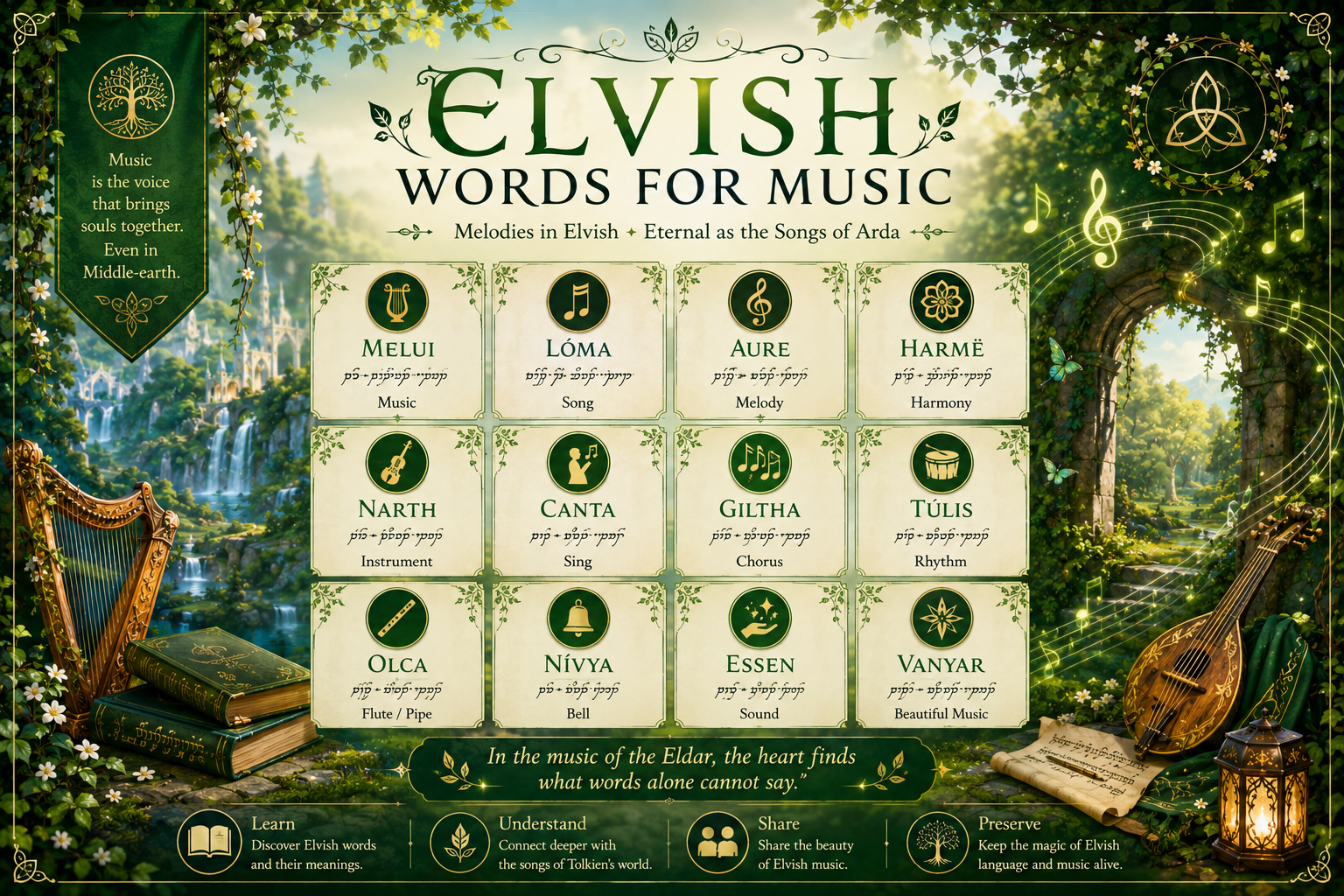
- Lindë – Quenya for “song” or “music,” forming the root behind several character and place associations tied to music
- Glîr – Sindarin for “song,” carrying a warmer, more everyday connotation than its Quenya counterpart
- Maglor-adjacent roots tied to singing specifically, reflecting how deeply music intertwines with character identity in Tolkien’s writing
- Ainulindalë – literally “Music of the Ainur,” the foundational creation song referenced throughout Tolkien’s broader mythology
Quenya vocabulary tends to dominate formal or foundational musical concepts, while Sindarin terms feel more suited to everyday singing and performance.
Sindarin or Quenya for Musical Phrases?
The familiar tonal split applies here as well:
- Sindarin words feel warmer and more immediate, fitting for everyday songs, lullabies, or casual musical expression
- Quenya words carry more formality and reverence, well suited for something meant to feel foundational or sacred
A lullaby or folk-style phrase probably belongs in Sindarin. A phrase invoking music’s creative, foundational power might sit better in Quenya’s more elevated register.
How Music Vocabulary Reflects Elvish Values
Elvish reverence for music mirrors the same values found throughout Sindarin and Quenya more broadly: careful attention to beauty, memory, and meaning rather than casual convenience. Songs in Tolkien’s writing frequently serve as historical records, passing down memory and story through melody rather than plain narration alone. This is part of why studying Elvish poetry and songs alongside vocabulary gives such a complete picture of how the languages actually function in practice.
That connection between music and memory also explains why so much emotionally significant vocabulary, farewell, hope, remembrance, appears woven directly into musical contexts throughout Tolkien’s writing.
Using Elvish Words for Music Thoughtfully
- Confirm whether a word belongs to Sindarin or Quenya before pairing it with other vocabulary
- Keep phrases simple, since elaborate musical or poetic constructions are harder to translate reliably
- Consider the context carefully; foundational or sacred-feeling phrases suit Quenya, while everyday musical expression suits Sindarin
- Cross-check meaning against more than one documented source before using it somewhere permanent
That first point matters more here than in some other categories, since musical vocabulary spans both languages fairly evenly, making mix-ups easier to accidentally introduce.
Final Thoughts
Elvish words for music and song reach back to the very foundation of Tolkien’s mythology, where the world itself began as melody rather than plain narration. Take the time to understand a word’s real register and origin, choose the language that matches your context, and remember that in Tolkien’s world, music was never just decoration. Approached with that understanding, a single musical phrase can carry echoes of something far older than the story itself.