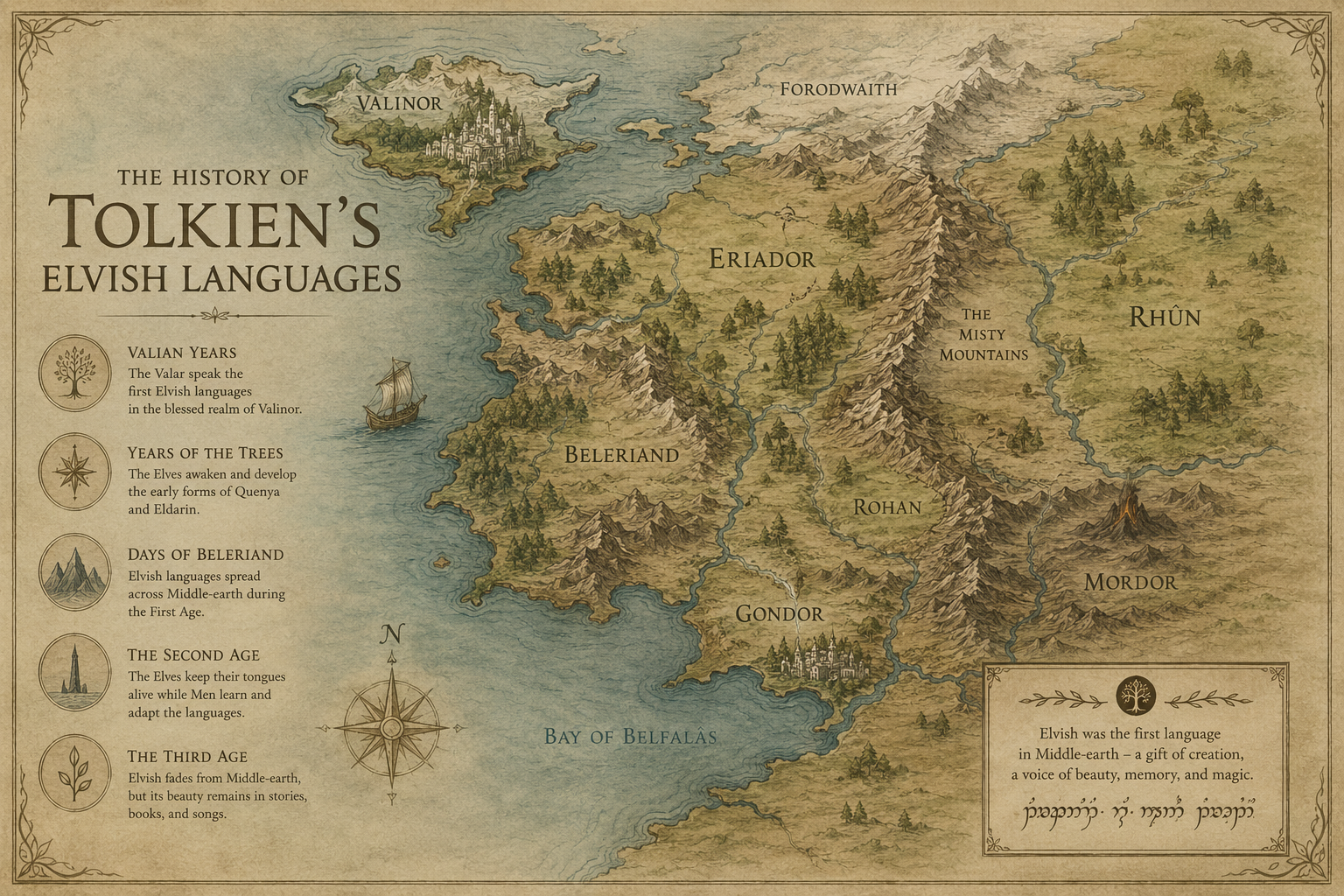
The History of Tolkien’s Elvish Languages
Most fictional languages get invented to fill a gap in a story. The history of Tolkien’s Elvish languages runs almost entirely backward from that. Tolkien built these languages first, sometimes decades before Middle-earth had anything resembling a plot, and the story eventually grew around them, not the other way around. Understanding that origin changes how you see every Elvish phrase you encounter today.
Here’s how it actually unfolded, from a schoolboy’s private hobby to one of the most detailed constructed language families ever created.
It Started as a Childhood Hobby
Long before The Lord of the Rings, a teenage Tolkien was already inventing private languages, partly inspired by cousins who created their own invented “Animalic” and “Nevbosh” languages as a game. That early fascination stuck. By his university years, Tolkien was studying Old English, Old Norse, Finnish, and Welsh in depth, and those languages became the raw material for something far more ambitious than a schoolboy hobby.
This wasn’t idle doodling. Tolkien kept building and revising these invented languages privately for most of his life, long before publishers or readers ever saw a page of Middle-earth.
Finnish and Welsh: The Real-World DNA
Two languages shaped Elvish more than any others, and their fingerprints are still visible today.
- Quenya grew largely out of Tolkien’s fascination with Finnish, particularly its complex case system and melodic sound patterns
- Sindarin developed later, drawing heavily from Welsh phonology, giving it that softer, more flowing quality compared to Quenya’s formality
Tolkien didn’t copy either language directly; he absorbed their underlying structures and reimagined them into something new, the same way a composer might study classical form before writing an original piece.
From Private Hobby to Mythology
Here’s the part that surprises most casual fans: Tolkien once said the languages came first, and the mythology of Middle-earth was built specifically to give them a home. Early invented tongues eventually split and evolved into what became Quenya and Sindarin, mirroring how real human languages branch apart over centuries of separation and migration.
That branching wasn’t random flavor text either. Tolkien tracked the internal history of these languages the way a historical linguist tracks real ones, complete with sound changes, migrations, and divergence over thousands of fictional years.
Decades of Revision
Tolkien never considered Elvish “finished.” He revised grammar rules, vocabulary, and even fundamental sound patterns repeatedly across his lifetime, sometimes contradicting earlier notes as his thinking evolved. This is part of why modern Elvish scholarship can feel layered; enthusiasts often distinguish between “early,” “middle,” and “late” versions of Tolkien’s linguistic thinking when analyzing specific words.
It’s less like studying one finished language and more like tracing the evolution of an idea across an entire lifetime of notes.
What Happened After Tolkien’s Death
Tolkien passed away in 1973 with an enormous volume of linguistic notes still unpublished. Since then, dedicated researchers and organizations have worked to organize, publish, and analyze that material, gradually expanding public understanding of Sindarin and Quenya grammar well beyond what appeared in his novels alone. This ongoing scholarship is exactly why serious Elvish translation today leans on published linguistic research rather than guesswork.
Why This History Matters for Modern Translation
Knowing the history of Tolkien’s Elvish languages explains why translation tools sometimes hit gaps or disagree slightly on grammar. These aren’t static, complete languages frozen in one form; they’re the product of decades of evolving notes, some published, some still being pieced together by researchers today. A translator that acknowledges this complexity, rather than presenting every answer with false certainty, is doing the material justice.
Final Thoughts
The history of Tolkien’s Elvish languages is really a story about a linguist who fell in love with language itself, decades before he ever needed one for a novel. From a teenager’s private hobby to one of literature’s most detailed invented language families, that history explains both the beauty and the limitations you’ll encounter in Elvish today, and it’s worth remembering the next time you see a single translated word.