Elvish Words for Peace and Hope
Some words get requested for quieter reasons than tattoos or wedding vows. A word for peace during a hard season, or a phrase for hope after loss, tends to come from something more personal, and Elvish words for peace and hope carry a kind of gentleness that fits those moments especially well. Tolkien built entire themes of his mythology around hope persisting through darkness, and that context shows up directly in the vocabulary itself.
Here’s what these words mean, and how to use them in a way that honors that context.
Why Hope Carries Special Weight in Tolkien’s Writing
Middle-earth’s stories return again and again to hope surviving impossible circumstances, often described using the Elvish concept of “estel,” a deeper, almost stubborn faith distinct from simple optimism. This wasn’t incidental. Tolkien wove hope and endurance through nearly every major storyline, which means Sindarin and Quenya both carry unusually rich, well-documented vocabulary around the concept compared to more modern, abstract emotions.
That depth is part of why these words resonate the way they do, even outside the context of the books themselves.
Common Words for Peace
A handful of terms appear consistently across Sindarin and Quenya resources:
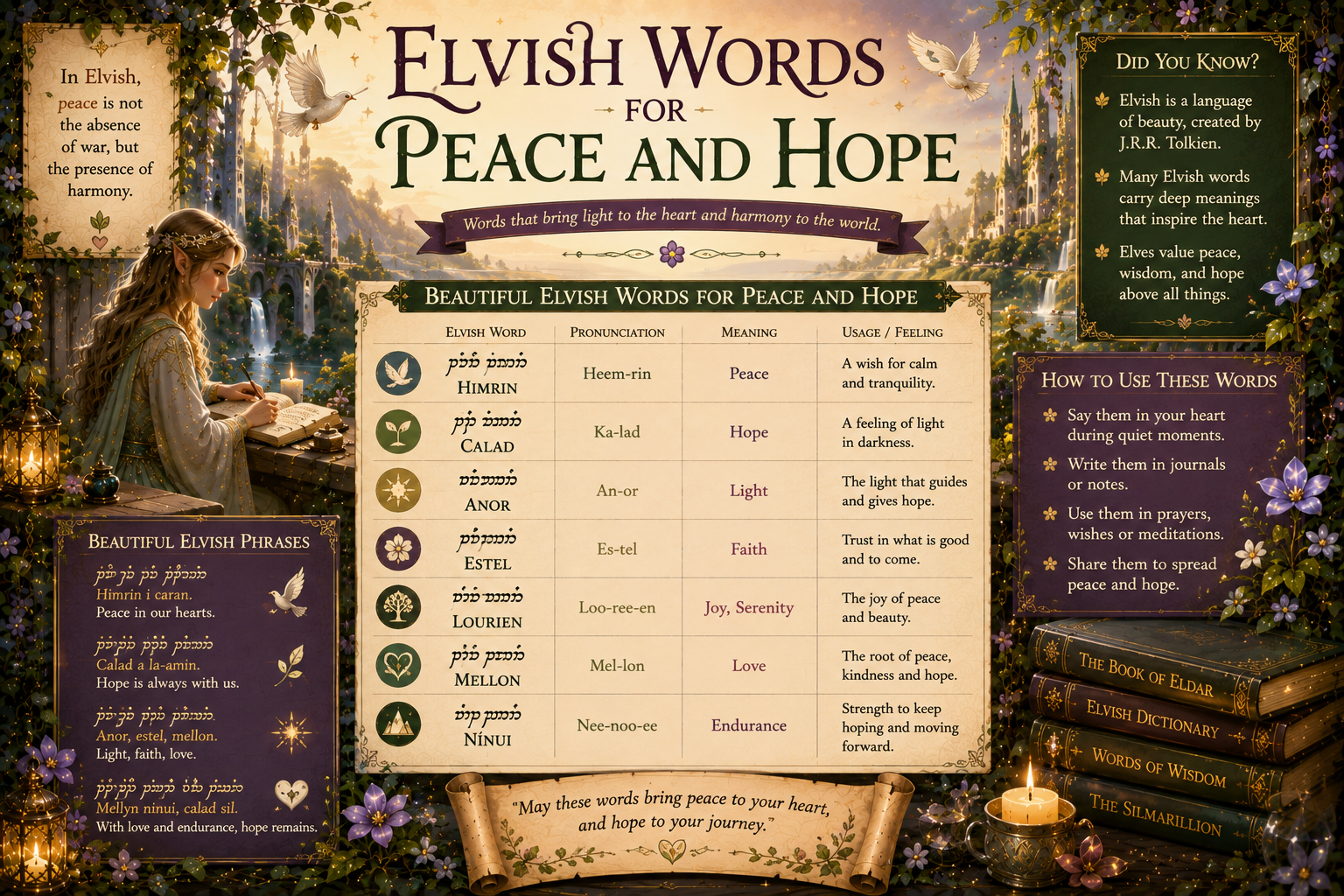
- Sîdh – Sindarin for “peace,” a direct, commonly referenced term
- Sérë – the Quenya equivalent, carrying a similarly calm, settled quality
- Dûr – sometimes associated with quiet stillness in certain Sindarin-derived interpretations, though less directly documented than “sîdh”
Sindarin’s version tends to feel gentle and immediate, while the Quenya alternative carries a slightly more formal, contemplative tone.
Common Words for Hope
Hope carries especially rich vocabulary, reflecting its central role in Tolkien’s storytelling:
- Estel – a Quenya word for hope, specifically the deeper, faith-like variety rather than casual optimism, famously used as a name within Tolkien’s writing
- Amdir – a Sindarin term for hope based on known, visible reasons for optimism, distinct from estel’s more unconditional quality
- Compound phrases invoking starlight alongside hope, tying back to Elvish reverence for stars as symbols of guidance through darkness
That distinction between “estel” and “amdir” is genuinely worth knowing. Tolkien built two different words specifically because he saw two different kinds of hope, one grounded in evidence and one that persists without it.
Sindarin or Quenya for These Words?
The familiar tonal pattern applies here as well:
- Sindarin words feel warmer and more immediate, suited for everyday comfort or a personal reminder
- Quenya words carry more weight and formality, fitting for something meant to feel timeless or deeply significant
A quiet personal keepsake might lean Sindarin. A phrase meant to carry real philosophical weight, like “estel,” might sit better in its original Quenya form specifically.
How to Use These Elvish Words for Peace and Hope Thoughtfully
- Confirm which specific type of hope you mean, since estel and amdir aren’t interchangeable despite both translating loosely to “hope”
- Keep phrases short, since Elvish vocabulary for these themes, while rich, still has documented limits
- Cross-check meaning against more than one source before permanent use
- Consider the emotional context carefully, especially if the word is meant to mark something difficult, like grief or recovery
That first point matters more than it might seem. Choosing “estel” over “amdir,” or the reverse, genuinely changes what the word is saying about the kind of hope you mean.
Final Thoughts
Elvish words for peace and hope carry real emotional precision, built from a mythology that took the difference between fleeting comfort and lasting faith seriously enough to give each one its own word. Take the time to understand exactly which meaning fits your situation, verify it against a documented source, and use it somewhere it can genuinely be appreciated. Chosen with that care, a single word can hold space for something words in English often flatten into one general idea.