Elvish Runes (Cirth): The Alphabet Tengwar Overshadowed
Most people picture flowing, calligraphic script when they think of Elvish writing, but that’s only half the story. Elvish runes, known as Cirth, represent an entirely different writing system, angular and carved rather than curved and penned, and they’re just as much a part of Tolkien’s linguistic world as Tengwar. They’re just far less famous.
Here’s what Cirth actually is, how it differs from Tengwar, and where you’ve probably already seen it without realizing.
What Cirth Actually Is
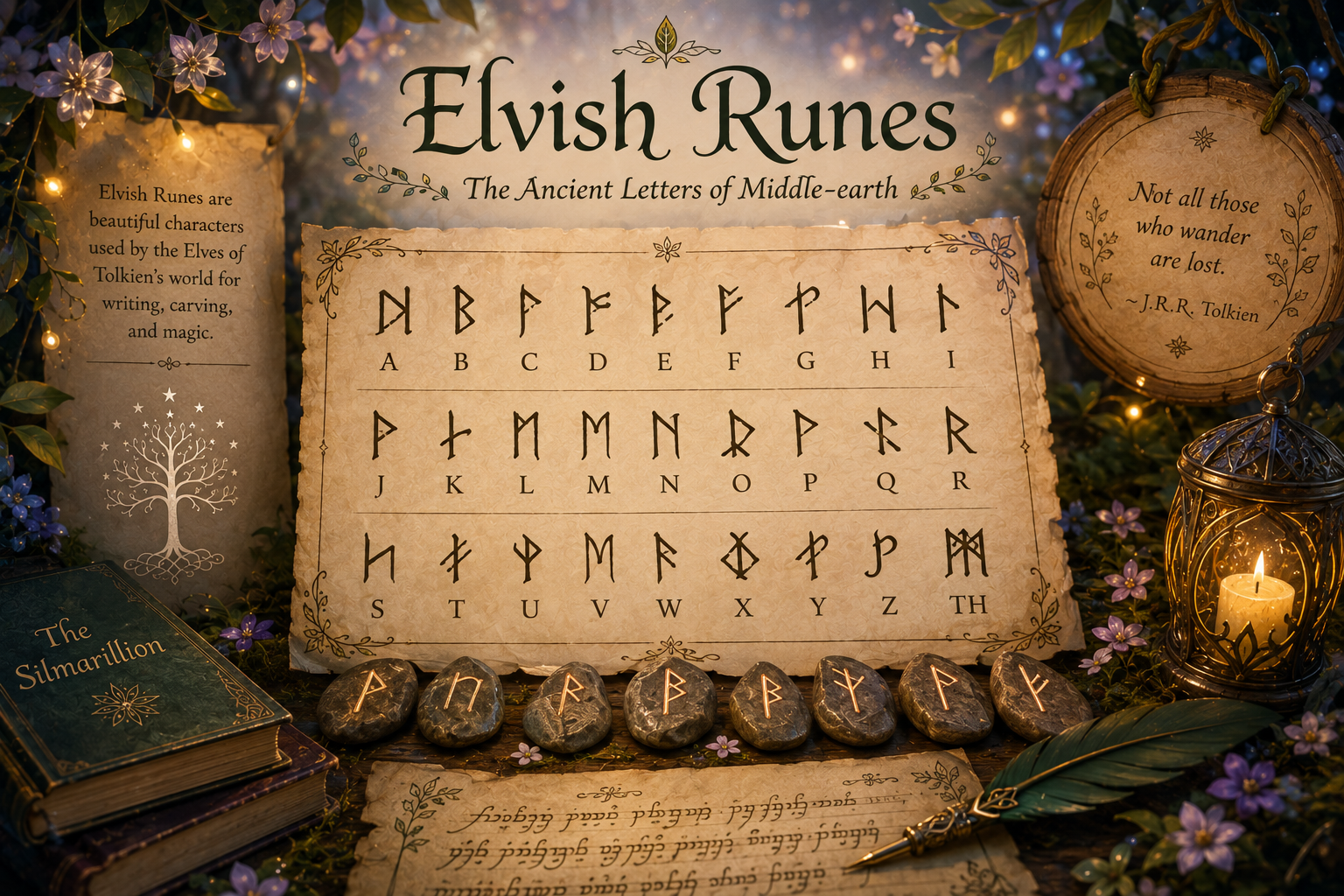
Cirth means “runes” in Sindarin, and true to that name, the script looks exactly like what you’d expect from a runic alphabet: straight lines and sharp angles, designed originally to be carved into wood or stone rather than written with a pen. Tolkien modeled Cirth loosely on real-world runic alphabets like the Germanic Futhark, giving it that same practical, chiseled appearance.
Unlike Tengwar, which Tolkien associated primarily with Elvish high culture and formal writing, Cirth was designed to feel older, rougher, and more universally practical across different peoples in Middle-earth.
Cirth vs. Tengwar: The Key Differences
The two systems aren’t interchangeable, and knowing the difference matters if you’re trying to identify or use either one correctly:
- Tengwar is flowing and curved, associated with pen-and-ink writing and Elvish formal culture
- Cirth is angular and straight-lined, associated with carving and originally developed by Elves before being widely adopted by Dwarves
- Tengwar represents sounds through a more complex system of shape and diacritical marks; Cirth functions more like a traditional one-symbol-per-sound alphabet
- Cirth appears more frequently in Dwarvish contexts within Tolkien’s later writing, even though Elves originally developed it
That last point surprises a lot of casual fans. Despite the name “Elvish runes,” Cirth became closely associated with Dwarves by the time of The Lord of the Rings, most famously on Balin’s tomb inscription in Moria.
Where You’ve Actually Seen Cirth Before
If you’ve watched adaptations of Tolkien’s work or handled tie-in merchandise, there’s a good chance you’ve encountered Cirth without knowing its name. It shows up on Dwarvish grave markers, weapon inscriptions, and map details throughout adapted material, often standing in as the “angular, ancient-looking” script wherever a carved or engraved aesthetic fits the scene better than flowing Tengwar would.
Its runic look also makes it a popular choice for jewelry and engravings where a chiseled, weathered aesthetic matters more than the more ornate feel Tengwar carries.
How Cirth Represents Sounds
Like Tengwar, Cirth was built with real linguistic logic rather than random symbol assignment. Each rune generally represents a single consonant or vowel sound, with related sounds often sharing similar angular shapes, echoing the same “family of sounds, family of symbols” logic found in real runic alphabets like Futhark.
This structural logic means Cirth can be learned with the same pattern-based approach that works well for Tengwar, just applied to a completely different visual system.
Should You Use Cirth or Tengwar for a Project?
The choice usually comes down to aesthetic and context rather than accuracy, since both are legitimate parts of Tolkien’s constructed writing systems:
- Choose Tengwar for something meant to feel elegant, formal, or distinctly Elvish in tone
- Choose Cirth for something meant to feel ancient, carved, rugged, or tied to Dwarvish culture
- For jewelry or engravings on stone or metal, Cirth’s angular shapes often suit the physical medium better
- For calligraphy, artwork, or anything meant to feel flowing, Tengwar remains the stronger visual choice
Neither system is more “correct” than the other; they simply carry different tones and associations within Tolkien’s world.
Final Thoughts
Elvish runes deserve far more attention than they typically get, overshadowed as they are by Tengwar’s more famous, flowing elegance. Understanding Cirth’s angular structure, its surprising association with Dwarves, and its practical, carved origins rounds out a fuller picture of how Tolkien built not just one writing system, but two entirely different ones, each suited to a different part of Middle-earth’s story.