Fun Facts About Elvish You Probably Didn’t Know
Even longtime fans who can recite entire passages from The Lord of the Rings often know surprisingly little about the languages behind the story itself. These fun facts about Elvish go beyond the usual trivia, covering the kind of detail that tends to make people pause mid-scroll and go, “wait, really?”
Here are some of the more overlooked details worth knowing.
1. Tolkien Built the Languages Before the Story
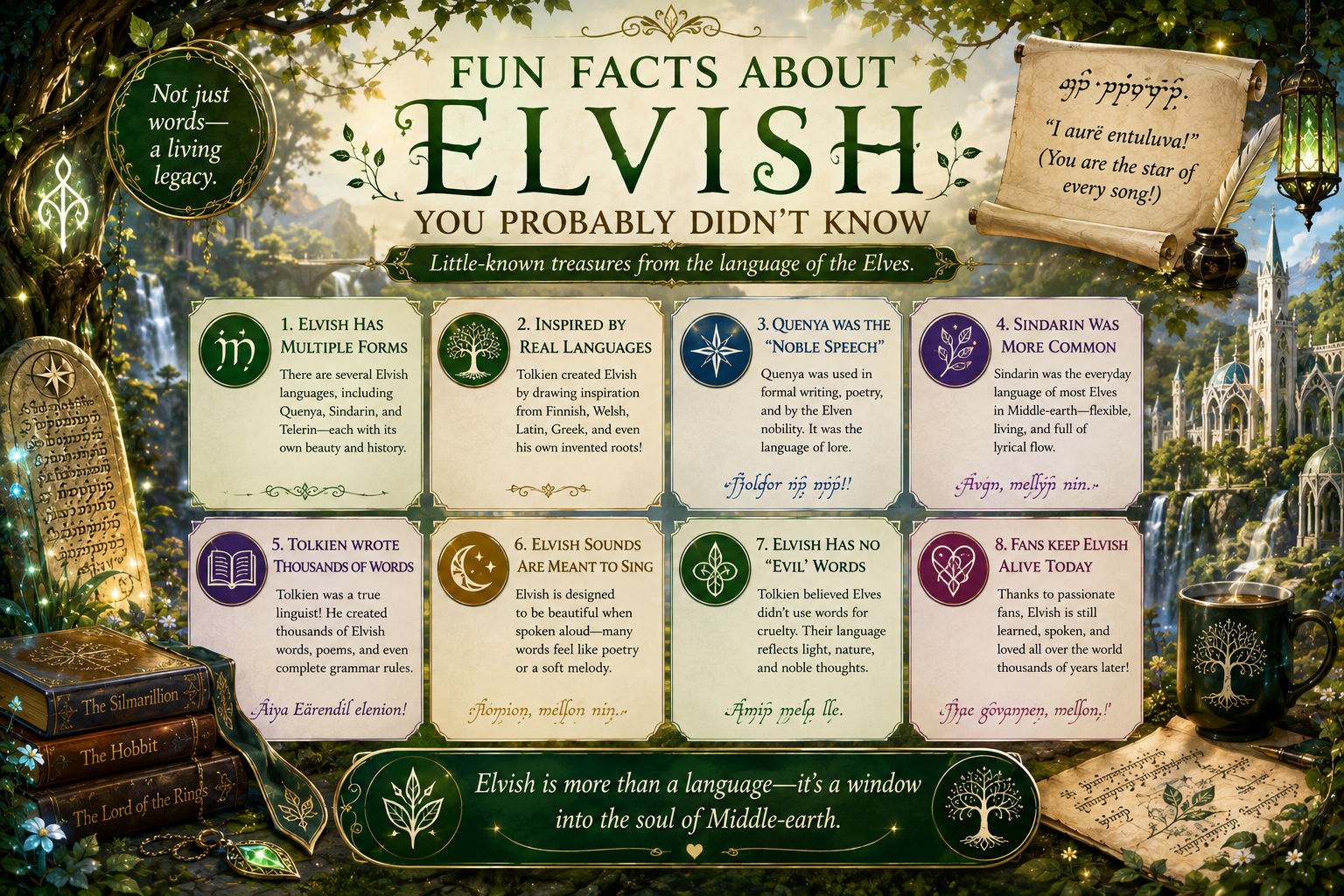
This one surprises almost everyone the first time they hear it. Tolkien didn’t invent Elvish to fill dialogue in an already-written story; he built the languages first, sometimes decades earlier, and grew Middle-earth’s mythology specifically to give them a place to exist. The story, in a very real sense, was built to serve the language, not the other way around.
2. Quenya Owes a Lot to Finnish
Tolkien once described discovering Finnish grammar as feeling like finding a wine cellar full of bottles he’d never tasted. That excitement shows up directly in Quenya, which borrows heavily from Finnish’s complex case system and melodic sound patterns. Without that one linguistic discovery, Quenya likely would have sounded completely different.
3. Sindarin’s Softness Comes From Welsh
If Sindarin feels gentler and more musical than Quenya, that’s not an accident. Tolkien drew heavily on Welsh phonology when shaping Sindarin, particularly its consonant mutations, where a word’s beginning shifts depending on what comes before it. It’s part of why Sindarin flows so differently from its more formal counterpart.
4. There Are More Than Two Elvish Languages
Most casual fans know Sindarin and Quenya, but Tolkien actually sketched out an entire family of Elvish languages and dialects, including earlier, more primitive forms that Quenya and Sindarin both branched from. Most of these remain far less developed, existing mainly in Tolkien’s private linguistic notes rather than his published fiction.
5. Some Words Genuinely Don’t Exist
This is one of the most important fun facts about Elvish for anyone planning a translation. Because Elvish was never finished as a complete modern language, there’s no documented Sindarin or Quenya word for things like “computer” or “telephone.” This is exactly why longer, modern-sounding phrases are much harder to translate accurately than short names or classic, nature-rooted vocabulary.
6. Tengwar Can Write Other Languages Too
Tengwar isn’t locked exclusively to Elvish. Tolkien designed it as a flexible writing system capable of representing multiple languages phonetically, including English. That’s why you’ll occasionally see Tengwar used to write English words directly, sound by sound, rather than translating them into Elvish vocabulary first.
7. Tolkien Kept Revising Elvish for Decades
Elvish wasn’t a “set it and forget it” project. Tolkien continued revising grammar rules, vocabulary, and even sound patterns throughout his life, sometimes contradicting his own earlier notes as his thinking evolved. Serious Elvish scholarship today often distinguishes between “early,” “middle,” and “late” conceptions of the language for exactly this reason.
8. A Real Academic Field Studies It
Elvish linguistics isn’t just a fandom hobby anymore. Dedicated researchers and organizations have spent decades organizing, analyzing, and publishing Tolkien’s unfinished linguistic notes, gradually expanding public understanding of Sindarin and Quenya grammar well beyond what appears in the novels alone.
Final Thoughts
These fun facts about Elvish reveal something most casual fans miss: this isn’t decorative fantasy dressing, it’s a genuinely deep linguistic project built by someone who happened to also be one of the twentieth century’s great storytellers. The more you learn about how these languages actually came together, the harder it becomes to see Elvish as anything less than one of fiction’s most impressive achievements.