Everyday Elvish Phrases You Can Actually Use
Not every Elvish phrase needs to be a dramatic blessing or a poetic line from a ceremony. Sometimes you just want to say hello, thank someone, or wish them well, the same small exchanges that make up most of daily conversation. Everyday Elvish phrases cover exactly that ground, giving you practical, usable vocabulary without requiring deep fluency first.
Here’s a starter set worth learning, along with the context that helps you use them naturally.
Why Start With Everyday Phrases
Jumping straight into long, formal translations can feel overwhelming, and honestly, it’s not the most useful place to begin. Short, common phrases give you repeated practice with pronunciation, expose you to basic grammar patterns, and build a foundation you can actually build on later. It’s the same reason most language courses teach “hello” before anything else.
There’s also a practical upside: everyday phrases tend to be some of the most reliably documented vocabulary, since Tolkien used greetings and simple exchanges fairly often throughout his writing.
Common Greetings
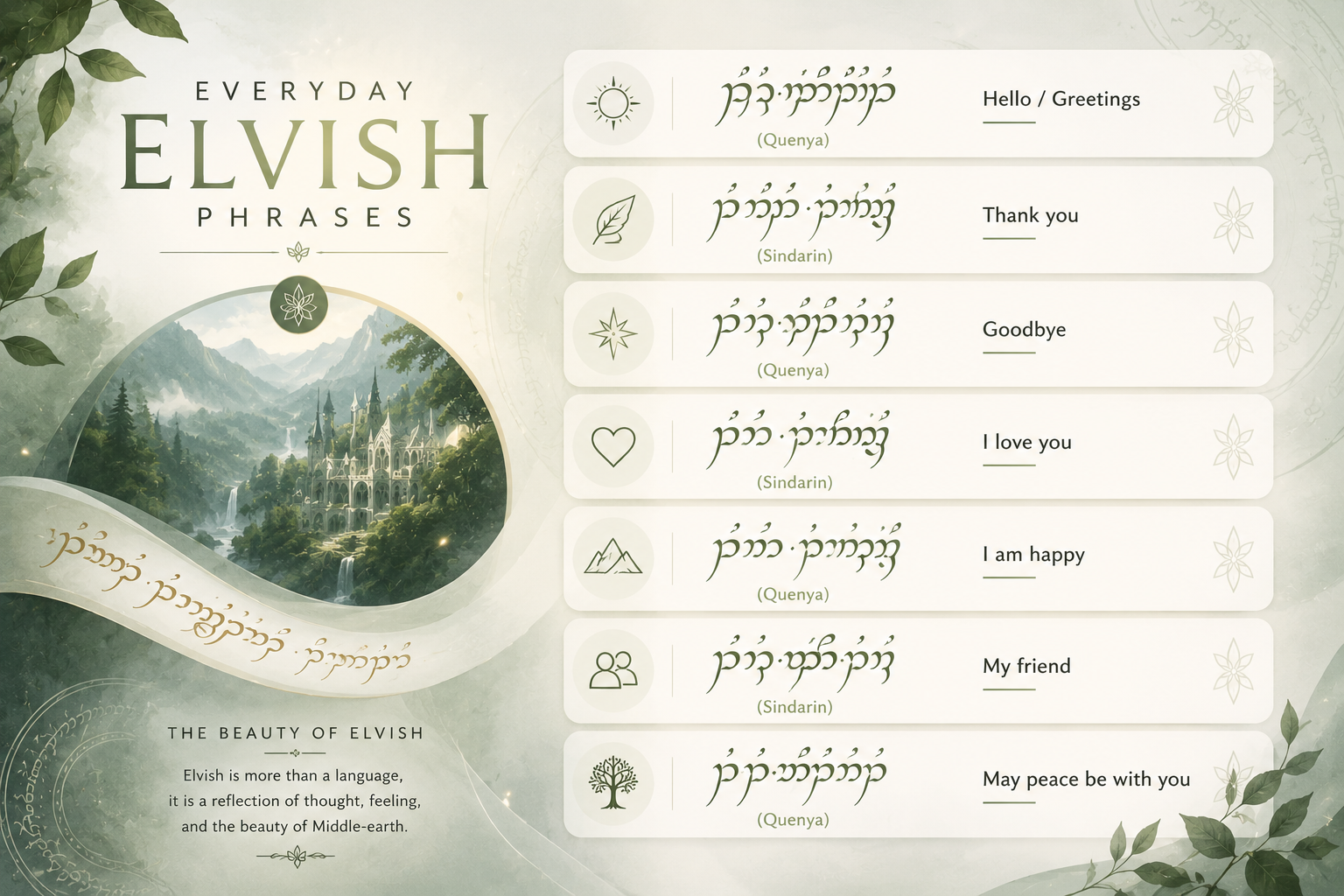
A few greetings show up consistently across Sindarin and Quenya resources:
- Mae govannen – Sindarin for “well met,” a warm, commonly used greeting
- Suilad – a simpler Sindarin word for “greetings” or “hello”
- Aiya – a Quenya greeting, often translated as “hail” or “hello,” carrying a slightly more formal tone
Sindarin greetings tend to feel more conversational, while Quenya options lean formal, so picking between them depends on the tone you’re going for.
Saying Thank You and Goodbye
- Hannon le – Sindarin for “thank you,” one of the most widely recognized everyday phrases among fans
- Navaer – a Sindarin farewell, generally used for a casual goodbye rather than a permanent one
- Namárië – a well-known Quenya farewell, but worth noting it carries a heavier, more final tone than a casual “see you later”
That distinction between “navaer” and “namárië” matters more than it seems. Using the wrong one can accidentally shift a casual goodbye into something far more dramatic.
Simple Well-Wishes
- Short phrases wishing safe travels are common in Sindarin, reflecting its role as the more commonly spoken Elvish tongue
- Brief blessings invoking light or stars appear more often in Quenya, tying back to Elvish reverence for starlight
- Keep well-wishes short; longer, elaborate versions are harder to translate accurately given Tolkien’s documented vocabulary
Simple, sincere phrasing consistently outperforms longer attempts here, mainly because there’s simply more documented vocabulary to draw from at the shorter end.
Tips for Using Everyday Elvish Phrases Naturally
- Practice each phrase aloud several times before trying to use it in context
- Confirm which language a phrase belongs to before pairing it with anything else you’ve learned
- Pay attention to tone; a Quenya farewell like “namárië” isn’t interchangeable with a casual Sindarin one
- Start with two or three phrases and get comfortable before adding more to your everyday vocabulary
Small, steady additions tend to stick far better than trying to memorize a long list all at once.
Mistakes to Avoid
- Using “namárië” for a casual goodbye when a lighter Sindarin farewell would fit better
- Mixing Sindarin and Quenya greetings within the same conversation without meaning to
- Assuming every English greeting or phrase has a direct, documented Elvish equivalent
- Skipping pronunciation practice, since these phrases are meant to be spoken, not just written
A little attention here goes a long way toward sounding natural rather than stiff.
Final Thoughts
Everyday Elvish phrases are a genuinely practical way to start engaging with Sindarin and Quenya beyond admiring translated names or ceremonial lines. Learn a handful at a time, pay attention to tone and context, and practice saying them aloud until they feel natural. Build that foundation, and the rest of Tolkien’s languages start to feel a lot less distant.