Elvish Words for Nature and What They Really Mean
Tolkien’s love of the natural world runs through nearly every page of his writing, so it’s no surprise that Elvish words for nature make up some of the richest, most carefully built vocabulary in either language. Trees, stars, rivers, and mountains weren’t just scenery in Middle-earth; they carried genuine reverence, and that reverence shows up directly in the words Elves use to describe them.
Here’s a look at where this vocabulary comes from, what it actually means, and how to use it well.
Why Nature Vocabulary Runs So Deep in Elvish
Elves in Tolkien’s mythology are deeply tied to the natural world, often described as its guardians and closest companions. That relationship shaped the languages themselves; Sindarin and Quenya both developed unusually rich vocabulary around trees, light, water, and stars compared to more abstract or modern concepts. It’s one of the clearest signs that Tolkien built these languages around a specific worldview, not just a generic fantasy aesthetic.
This is also why nature-themed words tend to be some of the most reliably documented, since Tolkien simply used them more often across his writing.
Common Elvish Words Tied to Nature
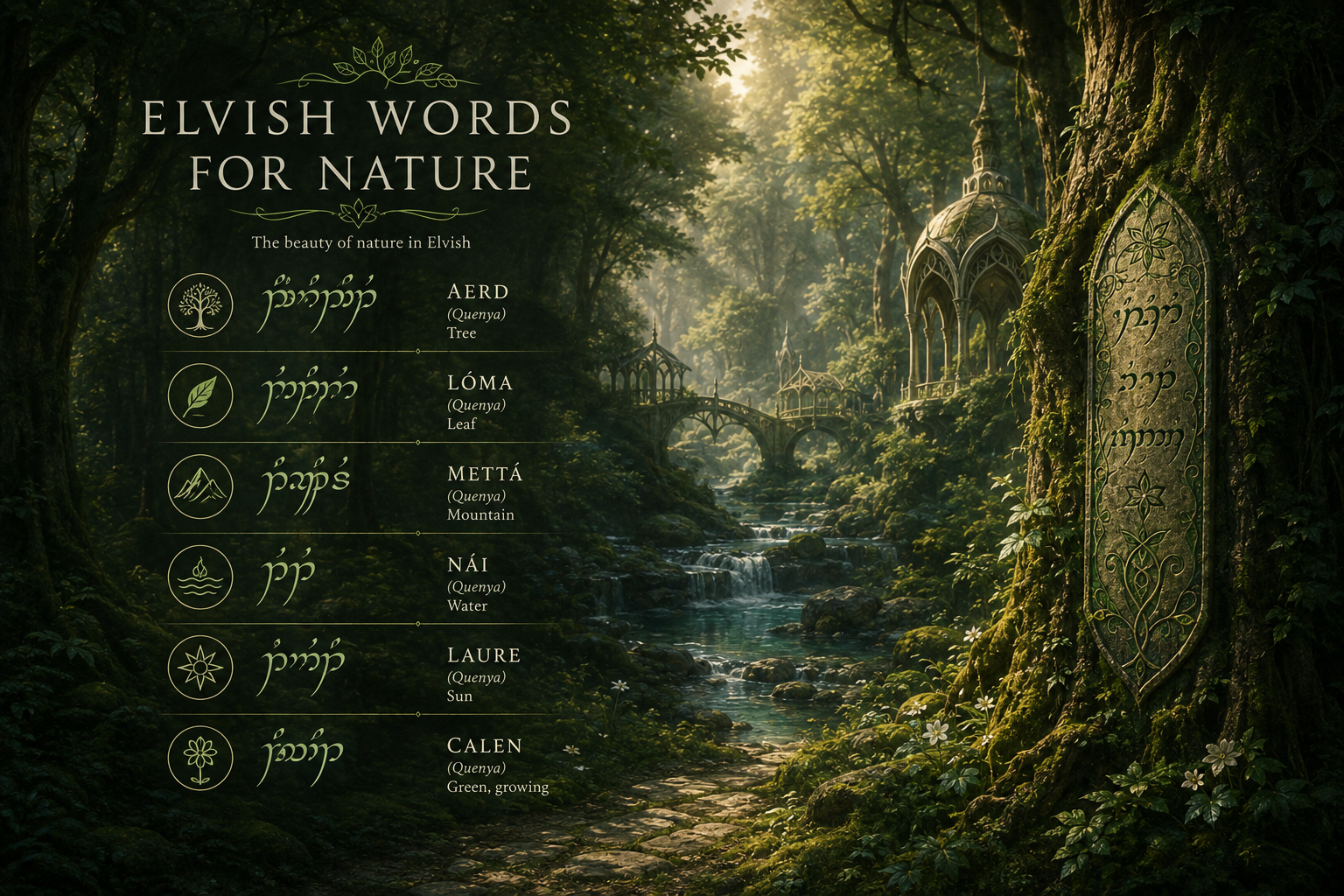
A handful of Elvish words for nature come up frequently across both languages:
- Galadh – Sindarin for “tree,” forming the root behind names like Galadriel
- Alda – the Quenya equivalent, also meaning “tree,” sharing the same conceptual root as its Sindarin counterpart
- Elen – “star” in Quenya, reflecting the deep Elvish reverence for starlight as a symbol of guidance and hope
- Nen – Sindarin for “water,” appearing in place names throughout Middle-earth
- Aear – Quenya for “sea,” carrying a sense of vastness and distant longing in Tolkien’s writing
Notice how many of these roots show up in character and place names. That’s not decorative either; Tolkien frequently built names directly from meaningful nature vocabulary.
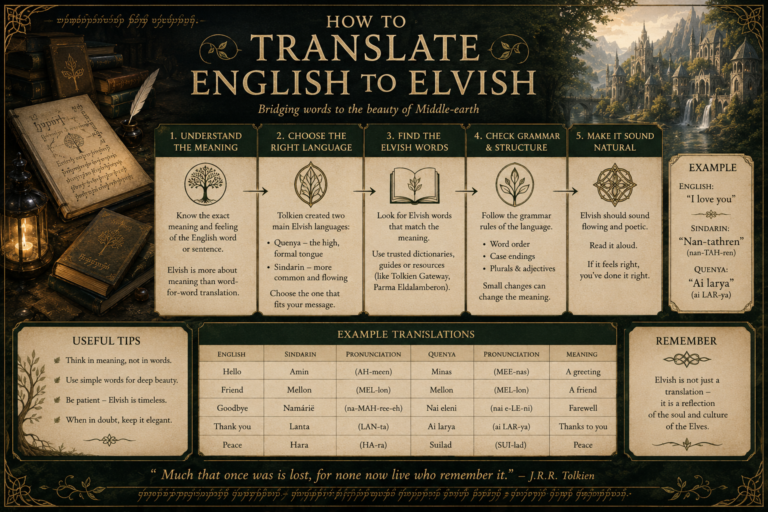
Sindarin or Quenya for Nature Words?
As with most Elvish vocabulary, tone drives the choice between languages:
- Sindarin nature words tend to feel grounded and immediate, fitting for everyday description or a name meant to feel warm
- Quenya nature words often carry a more elevated, almost reverent tone, well suited for something poetic or ceremonial
A phrase about a quiet forest walk probably leans Sindarin. A phrase evoking the vastness of starlight might sit more naturally in Quenya.
How to Use Nature Words Accurately
- Confirm the specific meaning behind a root word before pairing it with other vocabulary, since some nature terms shift meaning slightly depending on context
- Keep phrases short and grounded in documented vocabulary rather than attempting elaborate, poetic constructions
- Cross-check translations involving compound names, like “Galadriel,” since these often combine multiple root words together
- Stay consistent with one language throughout a single phrase or name
That third point trips up more people than expected. Compound Elvish names can look like a single word but actually carry two or three meaningful roots stitched together.
Mistakes to Avoid
- Assuming every nature-sounding word translates literally the way it might in English
- Mixing Sindarin and Quenya roots within the same compound word or phrase
- Overcomplicating a phrase when Tolkien’s simpler, documented vocabulary would communicate the same idea
- Skipping verification on compound names, which are easy to get subtly wrong
A little patience here goes a long way toward keeping a translation both accurate and genuinely meaningful.
Final Thoughts
Elvish words for nature carry some of the deepest, most carefully built vocabulary Tolkien ever created, reflecting a worldview where trees, stars, and water were never just background detail. Take the time to understand a root word’s real meaning, choose the language that matches your tone, and verify anything compound before committing to it. Handled with that care, a single nature-rooted word can carry the same weight as an entire descriptive sentence.