Elvish Translation FAQ: Your Questions, Answered
Certain questions come up again and again from anyone starting to explore Elvish translation, whether they’re naming a pet, planning a tattoo, or just curious how any of this actually works. This Elvish translation FAQ pulls together the answers worth knowing before you translate anything, in one place, without needing to dig through a dozen separate articles first.
Is Elvish a real language?
Yes, in the sense that matters linguistically. Tolkien, a professional philologist, built Sindarin and Quenya with genuine grammar, consistent sound systems, and documented vocabulary, the same underlying structure real languages have. What it isn’t is complete; Tolkien died before finishing a full modern vocabulary, so some concepts simply have no documented Elvish equivalent.
What’s the difference between Sindarin and Quenya?
They’re the two most developed languages in Tolkien’s Elvish family, but they aren’t interchangeable. Sindarin, inspired by Welsh, feels warmer and served as the everyday spoken tongue in Middle-earth. Quenya, inspired by Finnish and Latin, feels more formal and ceremonial. Mixing vocabulary between the two tends to produce results neither language would actually recognize.
How accurate is an online Elvish translation?
It depends entirely on the tool. A genuine Elvish translator works with documented Sindarin or Quenya vocabulary and explains its reasoning. Many popular “translators,” however, are actually font generators, simply reshaping English letters into Tengwar-style symbols without touching real Elvish vocabulary at all. Checking whether a tool distinguishes between languages and flags uncertainty is the fastest way to judge its accuracy.
Can every English word be translated into Elvish?
No, and any tool claiming otherwise deserves a skeptical eye. Tolkien’s documented vocabulary covers plenty of common concepts, but modern or abstract terms often have no direct equivalent. Short, simple phrases translate far more reliably than long, idiomatic English sentences.
Should I get an Elvish tattoo?
That’s a personal choice, but accuracy matters enormously once permanence is involved. Choose a short, well-documented phrase, verify it against more than one source, and get a written explanation of how it was translated, not just a finished image. Rushing this step is the single most common regret people report afterward.
What is Tengwar, and is it the same as Elvish?
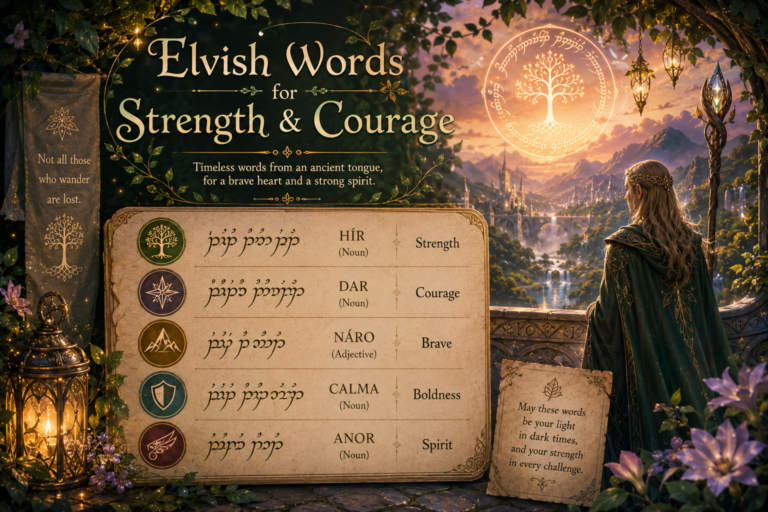
Tengwar is the writing system most commonly associated with Elvish, but it’s not a language itself; it’s a script capable of representing multiple languages, including Sindarin, Quenya, and even English phonetically. A word written in Tengwar isn’t automatically an Elvish translation unless the underlying vocabulary is actually Elvish too.
How do I learn to pronounce Elvish correctly?
Start with the vowel and consonant rules, since Elvish is consistently phonetic once you learn them. Pay close attention to details English speakers often miss, like a trailing “e” that’s never silent, or “dh” sounding like the “th” in “this.” Practicing short words aloud, rather than reading silently, builds pronunciation habits far faster.
Are movie versions of Elvish accurate?
Mostly, yes, though not perfectly. The Lord of the Rings films used a trained linguist to construct dialogue based on Tolkien’s own notes, filling documented gaps where necessary. Names and short established phrases are generally reliable; longer speeches involved more educated reconstruction.
Can I combine Sindarin and Quenya in one phrase?
It’s best avoided. The two languages have different grammar systems and vocabulary roots, so mixing them tends to produce a result that feels inconsistent to anyone familiar with either language individually. Pick one language and stay consistent throughout a single phrase or project.
Where can I verify an Elvish translation?
Cross-referencing more than one source is always the safest approach, especially before anything permanent. Community linguistic resources, published Tolkien scholarship, and a translator that explains its own reasoning all serve as useful checks against a single, unverified result.
Final Thoughts
Most Elvish translation questions come back to the same underlying theme: understanding what’s documented, what’s reconstructed, and what’s simply invented. Keep that distinction in mind, verify anything meant to last, and this Elvish translation FAQ should leave you with a lot less mystery and a lot more confidence.