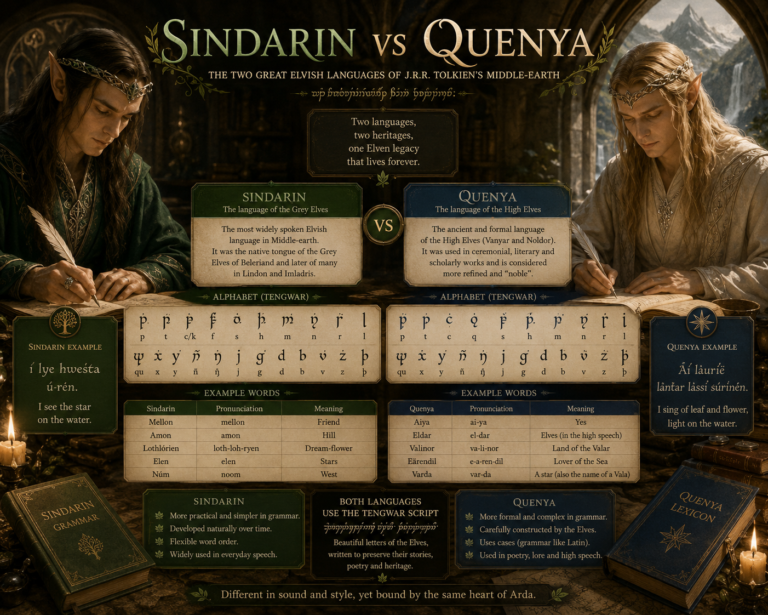
How to Pronounce Elvish Words the Right Way
Reading an Elvish word off a page is one thing. Saying it out loud with any confidence is a completely different challenge, and it’s the point where most beginners quietly give up. The good news is that Tolkien built his languages to be phonetic, which means once you learn a handful of core rules, you can pronounce Elvish words correctly on your first try, without ever hearing them spoken aloud first.
This guide covers exactly those rules, in plain language, with no linguistics degree required.
Why Elvish Pronunciation Is More Predictable Than English
English pronunciation is famously inconsistent. “Though,” “through,” and “tough” don’t rhyme despite looking like they should. Elvish doesn’t have that problem. Tolkien, a philologist by training, built Sindarin and Quenya so that letters consistently represent the same sounds, no exceptions hiding around the corner.
That consistency is genuinely good news for beginners. Learn the rules once, and they apply everywhere.
Core Vowel Sounds to Know
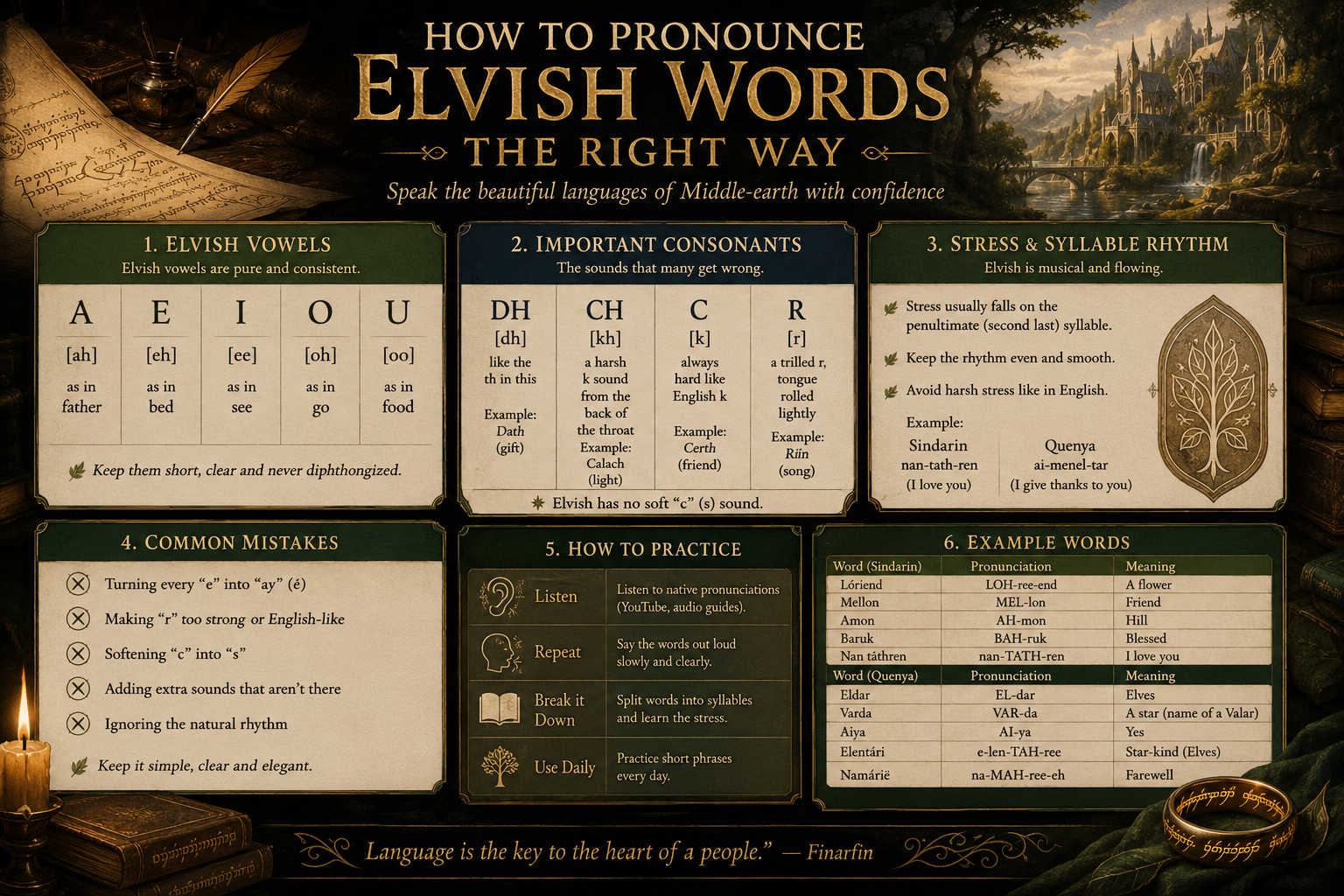
Vowels carry a lot of weight in Elvish pronunciation, and they follow fairly simple patterns:
- A sounds like the “a” in “father”
- E sounds like the “e” in “bed,” and is always pronounced, even at the end of a word
- I sounds like the “ee” in “see”
- O sounds like the “o” in “for”
- U sounds like the “oo” in “moon”
That last point about E is one beginners miss constantly. Unlike English, a trailing “e” in Elvish is never silent, so a name like “Arwen” ends with a clearly pronounced final syllable, not a swallowed one.
Consonants: Where Most Mistakes Happen
Most consonants behave the way you’d expect from English, but a few letter combinations are where people most often mispronounce Elvish words:
- Dh sounds like the “th” in “this,” not the “th” in “thin”
- Ch always sounds like the “ch” in the Scottish “loch,” never like “cheese”
- C is always hard, like a “k,” and never soft like in “cent”
- R is typically rolled or trilled, closer to Spanish or Scottish pronunciation than a flat American “r”
Getting these four right will instantly make your pronunciation sound more authentic, even before you’ve memorized much vocabulary.
Stress and Syllable Rhythm
Elvish words generally follow a predictable stress pattern: emphasis falls on the second-to-last syllable in most words, shifting to the third-to-last if that syllable is “light” (short and simple). It sounds technical written out, but in practice, your ear picks it up fast once you start reading words aloud rather than silently in your head.
Reading silently is actually where most learners stall. Elvish rewards being spoken, not just studied on a page.
A Simple Practice Method That Works
- Pick five short, common Elvish words to start
- Say each one slowly, exaggerating every syllable at first
- Record yourself and compare it to a native-style audio pronunciation if one’s available
- Gradually speed up until the word flows naturally
- Repeat with new words weekly rather than cramming a long list at once
Small, consistent practice beats occasional marathon sessions almost every time, especially with pronunciation, where muscle memory matters as much as knowledge.
Common Mistakes That Make People Mispronounce Elvish Words
- Silencing the final “e,” as English speakers instinctively do
- Softening “C” the way English does in words like “cent” or “circle”
- Flattening the rolled “R” into a standard American sound
- Rushing through multi-syllable names instead of pacing each syllable evenly
- Assuming Sindarin and Quenya pronunciation rules are identical, when small differences do exist between them
Avoiding just the first three will noticeably improve how natural your Elvish sounds.
Final Thoughts
Learning how to pronounce Elvish words isn’t about talent; it’s about rules, repetition, and a willingness to say things out loud even when they feel unfamiliar at first. Once the core vowel and consonant patterns click, most words stop feeling foreign and start feeling like something you can say with genuine confidence, whether you’re reading a translated name or reciting a phrase from Tolkien’s own pages.